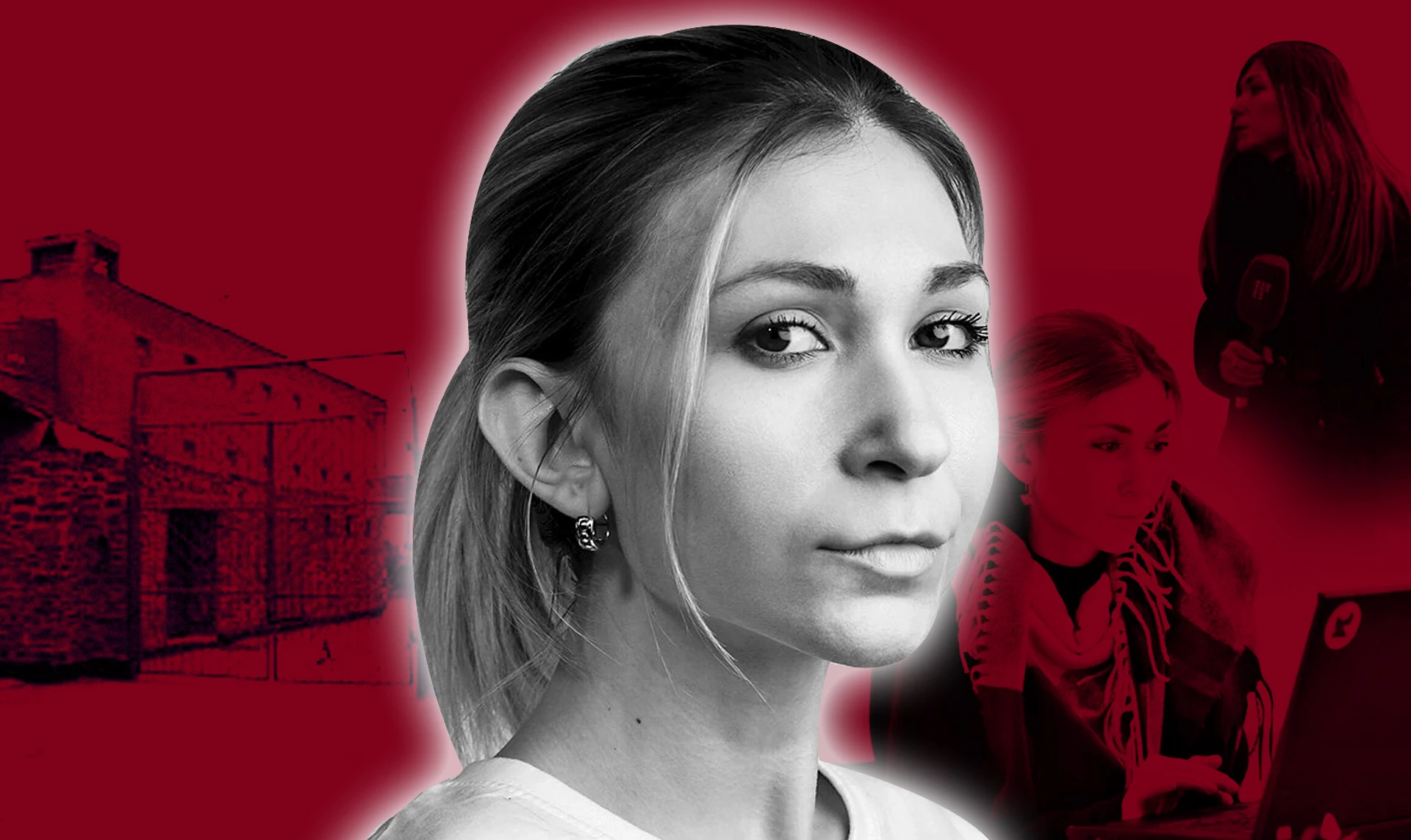
In Memoriam: Journalist Viktoria Roshchina, Who Had Everything Except Indifference
Source: Ukrainska Pravda
On October 10, the Russian Ministry of Defense informed Volodymyr Roshchin that his 27-year-old daughter, journalist Viktoria Roshchin, had died.
Viktoria went missing on August 3 of last year in the occupied part of the Zaporizhzhia region. She had traveled there to prepare another report.
For a long time, her father and colleagues tried to find out where Viktoria was. The journalist had already been held captive before—in March 2022, she was captured by Russian occupiers and held for ten days in Berdiansk.
It was not until April 2024—nine months after her August disappearance—that the Russians confirmed that Roshchina was in Russia. Why she was detained, what she is accused of, where she is being held, and what condition she is in—all of this remained unknown.
In September, Russia agreed to include Victoria in the next list for a prisoner exchange. Her family was waiting for her at home. But on September 13, the exchange took place, and Viktoria was left in captivity.
As stated in a letter from the Russian Ministry of Defense to Vladimir Roshchin, Viktoria died on September 19. Now they promise to return her “as part of an exchange of the bodies of detainees.”
Victoria entered journalism at age 16. She specialized in crime, human rights advocacy, and the judicial system. With the outbreak of full-scale war, she reported from hotspots and occupied territories. Some of her work was also published on “Ukrainska Pravda.”
Ukrainska Pravda recalls who Viktoria Roshchina
was, what she fought for, and what she believed in.
Sonya Lukashova, Ukrainska Pravda journalist and military servicemember
So much has been written about Vika these days. It’s so unfair that these words are being spoken only after her death.
She’s described as complex and controversial. Colleagues might have criticized her approach, deeming it unnecessarily risky, while the subjects of her stories might have criticized her and even threatened her. But this “complexity” wasn’t about being provocative. Vika simply believed in the purpose of her profession.
They call her persistent and stubborn. And it’s hard to find a more accurate description.
We often crossed paths in court. When things were “heating up” and “going off” all around her, Vika would pick up her phone, turn on the camera, and get to work. If she needed to film, she wasn’t intimidated by those who blocked her lens. If she needed to get into a place she wasn’t allowed, she argued her case. If she needed a comment, she wouldn’t let anyone get past her. And at the same time, she knew how to listen to everyone.
Working alongside her in those moments, I felt as if I were borrowing a bit of that tenacity, sensing its meaning and the unity of our profession. I’m ashamed that I didn’t repay that debt to her.
People call Vika brave. And that is, without a doubt, her defining trait.
There’s no need to explain how much courage it takes to work under occupation. Much is said about serving the truth in the hardest of times. She, however, did it without any unnecessary grandstanding.
But her courage was also evident in the everyday, in the less obvious.
Vika wasn’t afraid to be that complex and tenacious person. She wasn’t afraid to work alone: both physically, under occupation, and emotionally—without the sense of solidarity from her colleagues.
We often lack even this everyday courage.
So much has been written about you these days, Vika. It’s so unfair that all these words are being spoken only after your death. Because words are needed only for the living.
We must tell the living that they matter. We need to thank and support them more often. We need to love them more sincerely.
We must not simply repeat that we remember Vika. We must also have the courage to protect the profession for which she gave her life. We must have the courage to do this together, despite our differences.
We must be as dedicated to the cause as Vika was, even when she was left alone.
Olga Kyrylenko, war correspondent for UP
Vika was the bravest and most unyielding journalist I worked with at hromadske in 2018–2019. She asked—no, she demanded—that we include loooong quotes from prosecutors, dozens of photos from courtrooms, and detailed background information in her stories.
Vika fought for every word as if it determined the fate of the entire world. She believed in the importance of her work and of journalism as an institution more strongly than people believe in God. Rationally fanatical.
The most challenging topics—captured sailors in Moscow, the trials in the Handziuk and Maidan cases, weekend trips, holidays, and court sessions that dragged on into the night—that was all Vika. I remember how my colleague at the time, Pasha Kalashnik, relayed someone’s words from the newsroom: “Don’t give Vika any assignments today—it’s her day off. She decides for herself what to work on.”
My morning shifts at hromadske started at 7 a.m. I was often the first to arrive at the newsroom, the cleaning lady was second, and Vika was third. Even if the court proceedings lasted until late at night.
I watched Vika’s hard work and courage with admiration after the start of the full-scale war.
She did what none of us could do—she traveled to the occupied territories and brought back reports from there. Not for bonuses or recognition, but for the sake of the people. Just as we should all do.
I am deeply sorry.
Mykhailo Krygel, Deputy Editor-in-Chief of UP
Vika could have been anything—hardworking, easygoing, fanatically devoted to her work, demanding of herself and those around her, stubborn, difficult to deal with, ready to break through walls with her forehead, unbearable for editors.
She wouldn’t listen to anyone whose opinion on how (supposedly) to improve a text didn’t match her own. She was ready to fight for every sentence and every paragraph of her writing. Messaging apps would overheat during conversations with her; phones would fall and shatter—and that’s not a metaphor.
When she realized there was no point in arguing any further, she would write: “Then you have the right to reject the text. I’ll understand everything. You have your rules.” She’d move on to the next editor, and the whole thing would repeat itself.
She could be anything; she had it all.
What she never had was indifference. Neither toward the topics nor toward the people she wrote about.
She possessed what keeps journalism alive in the age of GPT—a genuine interest in her work, honesty with herself, and a love for the profession, rather than for herself within the profession.
Yevhen Buderatskyi, Deputy Editor-in-Chief of UP
Vika was one of the most challenging journalists I’ve ever worked with. At times she was unbearable; she’d react with hostility to any edits.
But despite everything, Vika always remained, above all, a Journalist. There was no stopping her once she set her mind to something.
And Russia killed her. No matter what they say now.
Sevgil Musaeva, Editor-in-Chief of UP
“Sevgil, hello! This is journalist Viktoria Roshchina. I’m very grateful to you for the opportunity to publish my work and for your moral support! Please tell me, is there anything else I can do to help you? I understand that your team is already established, but perhaps I could submit stories from time to time or help with other tasks?”—this was Vika Roshchina’s first message in October 2022.
She had just returned from the occupied territories, where she had been preparing a report on the referendums that the Russian side was holding in Mariupol and Berdiansk. Vika went there on her own, without an assignment from any Ukrainian news outlet, because she saw a need and a necessity to do so. It’s important not to forget about our people under occupation.
“You should go to the Women Courage Award ceremony in New York. Take a little break,” I wrote to her later.
“I won’t go; I didn’t have time to get a visa in September because I had to work on the referendums,” she replied.
And in that reply was the Vika her colleagues remembered.
We, Ukrainian journalists, are currently mostly focused on covering the front lines and mobilization issues. All this time, Vika wanted to be—and was—the voice of those who were hard to hear.
“I have to be there because no one else will cover this story; no one else will write about it,” she replied when asked not to take risks.
There was a lot of stubbornness in that, but at the same time, it showed her humanity toward those who found themselves in territories not controlled by Ukraine.
Just look at her report on the “road of life”—the village of Vasylivka, through which Ukrainians pass to reach territory controlled by Ukraine. Vika spent two weeks with these people, sleeping in her car and on the floor of the local cultural center. To share her experience, document it, and draw attention to it.
I remember how she took on the story of Tigran Oganisyan and Mykyta Khanganov from Berdiansk, who were shot by the occupiers, and then refused for a long time to return the boys’ bodies to their families. Vika called the families of the deceased every day to find out if they had received permission to bury them. And she wrote about the young men in her extensive report, which was based entirely on the accounts of their relatives living under occupation.
She was in the right place at the right time.
“I’m in Dnipro—do you need a report on the debris clearance at the building?” Victoria wrote two hours after the tragedy.
And that same evening, she sent the text, haggling with the editors over every word and every photo.
Vika embodies dedication to her profession until the very last moment of her life.
We, Ukrainian journalists, have lost the bravest among us.
5 stories by Viktoria Roshchina, written after the full-scale invasion
Death and Life in Devastated Mariupol. Photo Essay
On May 9, 2022, as Russia once again celebrated Victory Day, Viktoria Roshchina visited Mariupol.
She saw Russian and “DPR” tricolor flags against the backdrop of ruined buildings, heard Soviet songs amid the rhythms of explosions in the “Azovstal” area, spoke with people in the lines that have quickly become a common sight in the city, and documented the speech by the collaborationist mayor Ivashchenko, who restored the square’s old name—Lenin Komsomol Square—to the Square of Liberating Soldiers.
Victoria reported on how the occupiers celebrated their “victory” amid the city’s ruins.
An “DPR” occupier near the Metro station, where Mariupol residents receive humanitarian aid
Photo: Viktoria Roshchina
Excerpt from the text:
Near the drama theater, I met a local man. He was leisurely riding his bicycle down the road. At one intersection, the occupiers addressed him in Chechen and gestured for him to get out of the way.
“They’re going to tell me what I’m doing wrong,” the man says indignantly. “And I can still see the image before my eyes of how, near the drama theater, I saw nothing but pieces of flesh. Those were the bodies of my friend’s deceased relatives. The boy is 18 years old; he hasn’t even seen life yet, and he’s already been through hell.
Who could ever forget all this? Who could erase it from their memory?”
Snipers on the roof, a wounded “mayor,” and Russian tricolor flags. How Russia
Day Was Spent in Occupied Energodar
In June 2022, Viktoria Roshchina travels to occupied Energodar, where she was last in early March, when Ukrainian flags were still flying over the city. Finding herself in the city of energy workers on Russia Day, she admits that it is now unrecognizable.
Her camera captures armed Russian soldiers, civilians who hardly ever smile, a scene in the main square where people are thanking Putin, trucks bearing the letter “Z,” and Russian flags. So many Russian flags.
Excerpt from the text:
How did I feel? Rage and hatred. Toward Russia, which had invaded my home, and toward the people who were holding Russian tricolors and handing them out to children.
Those who show even the slightest pro-Ukrainian stance have long been on the occupiers’ “watch list” or in their basements. They are suffering for their beliefs while the “lovers of the Russian world” are drinking alcohol in the center of the occupied city.
And that’s exactly how life is in Energodar right now. It’s as if we’re living in some kind of parallel reality.
“I don’t even know anymore if it’s Putin or a robot.” Life in occupied Crimea during the war
Crimea in October 2022 means a blown-up bridge across the Kerch Strait. It means a yellow terror threat level. It means ongoing mobilization. Military planes circle in the sky. There are almost no tourists to be seen. And at gas stations and in stores—there’s a mad rush.
Viktoria boards a bus to Crimea—it now departs from the newly occupied territories. She deletes all photos and files from her phone that might raise questions at checkpoints and comes up with a “cover story” for herself.
Over the next few days, she’ll visit Simferopol, Kerch, Yalta, and Sevastopol to understand what life is like on the peninsula today and what its residents think about the war and a possible return to Ukraine.
Excerpt from the text:
In Simferopol, on my way to the train station, I meet a woman from Moscow. She came to Crimea to visit a health resort.
“I’m not against Putin; he’s doing a great job, holding his ground, and going through a lot. Look how bad he looks now,” the woman says. “But they left him no choice. If it weren’t for Putin’s decision, we might have been sitting in basements just like that back in March…”
In addition, she mentions the possibility of the Russian president having body doubles.
“There are so many options for plastic surgery these days…,” the woman says. “I don’t even know anymore if it’s Putin or a robot.”
“She had her whole life ahead of her… or so it was supposed to be.” Stories of children killed by a Russian missile in a high-rise building in Dnipro
On January 14, 2023, Russia struck a high-rise building in Dnipro with a missile. Footage of the destroyed building shocked the entire country. Forty adults and six children were killed in that tragedy.
Mykita Zelenskyy was set to turn one in two weeks—he was growing up to be an obedient little boy. Fifteen-year-old Mariyka Lebid was president of the student council and enjoyed ballroom dancing. At 17, Maksym Bohutskyi played soccer and loved to travel. The sisters Leila and Mykhailina Frantsev were 10 years apart in age. 1.5-year-old Makar Guz died alongside his parents: an acrobatics coach and a police officer.
In her report from Dnipro, Roshchina decided to give a voice to them—the children whose lives were cut short by a Russian missile.
A grandmother shows the last video of her grandson, Mykyta Zelenskyy
Photo: Viktoria Roshchina
Excerpt from the text:
Seventeen-year-old Maksym Bohutskyi was also killed by an enemy missile.
His father, Dmytro, told us in an interview that on that day, he and his wife had gone to their godmother’s birthday party, while Maksym had other plans—a meeting with friends at 4:00 p.m. However, at 3:00 p.m., an air raid alert was issued, and reports came in about two missiles heading toward Dnipro.
“I called him and asked him to wait it out at home, since it would take him 20 minutes to walk down the street,” his father recounts, pausing from time to time as tears well up. “He said, ‘Okay, I’ll wait it out at home.’ Those were his last words. At 3:30 p.m., a missile struck, and he didn’t answer the phone anymore,” Maxim’s father recalls.
Putin’s Path to The Hague Through “Filtration” and “Rehabilitation.” How Russia is Abducting Ukrainian Children
As of last May, Russia had taken at least 19,000 minors from the newly occupied Ukrainian territories. Were all the children taken by force? Who, besides the Russians, is facilitating attempts to “Russify” Ukrainian children? What methods does the Russian Federation use to “re-educate” young Ukrainians, and is our government doing enough to bring them back to their homeland? Roshchina provided answers to these questions in an in-depth article for UP.
In addition, she spoke with dozens of children whom Ukraine managed to bring back, identified the locations where they were held, the methods used to abduct them, and the names and positions of the Russians who facilitated the crime.
Excerpt from the article:
16-year-old Vitaliy from Beryslav ended up in a Crimean camp last fall.
“They didn’t treat us like human beings. They forced us to sing the Russian national anthem, and those who didn’t sing were taken to a separate room for a ‘chat,’ threatened with the basement, and told that those who were already 18 would be sent to the army, while the others would be sent all over Russia,” Vitaliy recalls.
“When they brought us there, they said, ‘Ukraine is made up of terrorists; they kill people.’ They beat us with sticks for saying ‘Glory to Ukraine!’ They swore at us and called us ‘khokhly.’ When one girl hung a Ukrainian flag in the room, they burned it,” the young man said.
You can read other articles by Viktoria Roshchina here.
Information for transferring funds to support Viktoria Roshchina’s
family
ACCOUNT NUMBER for deposits: 4149 4991 4394 6851
Recipient: Volodymyr Mykhailovych
Roshchin
Account number: 26208888025983
IBAN: UA173052990000026208888025983
Recipient’s Tax ID: 2242108198
Recipient’s Bank: JSC CB “PrivatBank,” Kyiv, Ukraine MFO: 305299
Payment Purpose: Charitable donation to support Viktoria Roshchina's family
On October 10, the Russian Ministry of Defense informed Volodymyr Roshchin that his 27-year-old daughter, journalist Viktoria Roshchin, had died.
Viktoria went missing on August 3 of last year in the occupied part of the Zaporizhzhia region. She had traveled there to prepare another report.
For a long time, her father and colleagues tried to find out where Viktoria was. The journalist had already been held captive before—in March 2022, she was captured by Russian occupiers and held for ten days in Berdiansk.
It was not until April 2024—nine months after her August disappearance—that the Russians confirmed that Roshchina was in Russia. Why she was detained, what she is accused of, where she is being held, and what condition she is in—all of this remained unknown.
In September, Russia agreed to include Victoria in the next list for a prisoner exchange. Her family was waiting for her at home. But on September 13, the exchange took place, and Viktoria was left in captivity.
As stated in a letter from the Russian Ministry of Defense to Vladimir Roshchin, Viktoria died on September 19. Now they promise to return her “as part of an exchange of the bodies of detainees.”
Victoria entered journalism at age 16. She specialized in crime, human rights advocacy, and the judicial system. With the outbreak of full-scale war, she reported from hotspots and occupied territories. Some of her work was also published on “Ukrainska Pravda.”
Ukrainska Pravda recalls who Viktoria Roshchina
was, what she fought for, and what she believed in.
Sonya Lukashova, Ukrainska Pravda journalist and military servicemember
So much has been written about Vika these days. It’s so unfair that these words are being spoken only after her death.
She’s described as complex and controversial. Colleagues might have criticized her approach, deeming it unnecessarily risky, while the subjects of her stories might have criticized her and even threatened her. But this “complexity” wasn’t about being provocative. Vika simply believed in the purpose of her profession.
They call her persistent and stubborn. And it’s hard to find a more accurate description.
We often crossed paths in court. When things were “heating up” and “going off” all around her, Vika would pick up her phone, turn on the camera, and get to work. If she needed to film, she wasn’t intimidated by those who blocked her lens. If she needed to get into a place she wasn’t allowed, she argued her case. If she needed a comment, she wouldn’t let anyone get past her. And at the same time, she knew how to listen to everyone.
Working alongside her in those moments, I felt as if I were borrowing a bit of that tenacity, sensing its meaning and the unity of our profession. I’m ashamed that I didn’t repay that debt to her.
People call Vika brave. And that is, without a doubt, her defining trait.
There’s no need to explain how much courage it takes to work under occupation. Much is said about serving the truth in the hardest of times. She, however, did it without any unnecessary grandstanding.
But her courage was also evident in the everyday, in the less obvious.
Vika wasn’t afraid to be that complex and tenacious person. She wasn’t afraid to work alone: both physically, under occupation, and emotionally—without the sense of solidarity from her colleagues.
We often lack even this everyday courage.
So much has been written about you these days, Vika. It’s so unfair that all these words are being spoken only after your death. Because words are needed only for the living.
We must tell the living that they matter. We need to thank and support them more often. We need to love them more sincerely.
We must not simply repeat that we remember Vika. We must also have the courage to protect the profession for which she gave her life. We must have the courage to do this together, despite our differences.
We must be as dedicated to the cause as Vika was, even when she was left alone.
Olga Kyrylenko, war correspondent for UP
Vika was the bravest and most unyielding journalist I worked with at hromadske in 2018–2019. She asked—no, she demanded—that we include loooong quotes from prosecutors, dozens of photos from courtrooms, and detailed background information in her stories.
Vika fought for every word as if it determined the fate of the entire world. She believed in the importance of her work and of journalism as an institution more strongly than people believe in God. Rationally fanatical.
The most challenging topics—captured sailors in Moscow, the trials in the Handziuk and Maidan cases, weekend trips, holidays, and court sessions that dragged on into the night—that was all Vika. I remember how my colleague at the time, Pasha Kalashnik, relayed someone’s words from the newsroom: “Don’t give Vika any assignments today—it’s her day off. She decides for herself what to work on.”
My morning shifts at hromadske started at 7 a.m. I was often the first to arrive at the newsroom, the cleaning lady was second, and Vika was third. Even if the court proceedings lasted until late at night.
I watched Vika’s hard work and courage with admiration after the start of the full-scale war.
She did what none of us could do—she traveled to the occupied territories and brought back reports from there. Not for bonuses or recognition, but for the sake of the people. Just as we should all do.
I am deeply sorry.
Mykhailo Krygel, Deputy Editor-in-Chief of UP
Vika could have been anything—hardworking, easygoing, fanatically devoted to her work, demanding of herself and those around her, stubborn, difficult to deal with, ready to break through walls with her forehead, unbearable for editors.
She wouldn’t listen to anyone whose opinion on how (supposedly) to improve a text didn’t match her own. She was ready to fight for every sentence and every paragraph of her writing. Messaging apps would overheat during conversations with her; phones would fall and shatter—and that’s not a metaphor.
When she realized there was no point in arguing any further, she would write: “Then you have the right to reject the text. I’ll understand everything. You have your rules.” She’d move on to the next editor, and the whole thing would repeat itself.
She could be anything; she had it all.
What she never had was indifference. Neither toward the topics nor toward the people she wrote about.
She possessed what keeps journalism alive in the age of GPT—a genuine interest in her work, honesty with herself, and a love for the profession, rather than for herself within the profession.
Yevhen Buderatskyi, Deputy Editor-in-Chief of UP
Vika was one of the most challenging journalists I’ve ever worked with. At times she was unbearable; she’d react with hostility to any edits.
But despite everything, Vika always remained, above all, a Journalist. There was no stopping her once she set her mind to something.
And Russia killed her. No matter what they say now.
Sevgil Musaeva, Editor-in-Chief of UP
“Sevgil, hello! This is journalist Viktoria Roshchina. I’m very grateful to you for the opportunity to publish my work and for your moral support! Please tell me, is there anything else I can do to help you? I understand that your team is already established, but perhaps I could submit stories from time to time or help with other tasks?”—this was Vika Roshchina’s first message in October 2022.
She had just returned from the occupied territories, where she had been preparing a report on the referendums that the Russian side was holding in Mariupol and Berdiansk. Vika went there on her own, without an assignment from any Ukrainian news outlet, because she saw a need and a necessity to do so. It’s important not to forget about our people under occupation.
“You should go to the Women Courage Award ceremony in New York. Take a little break,” I wrote to her later.
“I won’t go; I didn’t have time to get a visa in September because I had to work on the referendums,” she replied.
And in that reply was the Vika her colleagues remembered.
We, Ukrainian journalists, are currently mostly focused on covering the front lines and mobilization issues. All this time, Vika wanted to be—and was—the voice of those who were hard to hear.
“I have to be there because no one else will cover this story; no one else will write about it,” she replied when asked not to take risks.
There was a lot of stubbornness in that, but at the same time, it showed her humanity toward those who found themselves in territories not controlled by Ukraine.
Just look at her report on the “road of life”—the village of Vasylivka, through which Ukrainians pass to reach territory controlled by Ukraine. Vika spent two weeks with these people, sleeping in her car and on the floor of the local cultural center. To share her experience, document it, and draw attention to it.
I remember how she took on the story of Tigran Oganisyan and Mykyta Khanganov from Berdiansk, who were shot by the occupiers, and then refused for a long time to return the boys’ bodies to their families. Vika called the families of the deceased every day to find out if they had received permission to bury them. And she wrote about the young men in her extensive report, which was based entirely on the accounts of their relatives living under occupation.
She was in the right place at the right time.
“I’m in Dnipro—do you need a report on the debris clearance at the building?” Victoria wrote two hours after the tragedy.
And that same evening, she sent the text, haggling with the editors over every word and every photo.
Vika embodies dedication to her profession until the very last moment of her life.
We, Ukrainian journalists, have lost the bravest among us.
5 stories by Viktoria Roshchina, written after the full-scale invasion
Death and Life in Devastated Mariupol. Photo Essay
On May 9, 2022, as Russia once again celebrated Victory Day, Viktoria Roshchina visited Mariupol.
She saw Russian and “DPR” tricolor flags against the backdrop of ruined buildings, heard Soviet songs amid the rhythms of explosions in the “Azovstal” area, spoke with people in the lines that have quickly become a common sight in the city, and documented the speech by the collaborationist mayor Ivashchenko, who restored the square’s old name—Lenin Komsomol Square—to the Square of Liberating Soldiers.
Victoria reported on how the occupiers celebrated their “victory” amid the city’s ruins.
An “DPR” occupier near the Metro station, where Mariupol residents receive humanitarian aid
Photo: Viktoria Roshchina
Excerpt from the text:
Near the drama theater, I met a local man. He was leisurely riding his bicycle down the road. At one intersection, the occupiers addressed him in Chechen and gestured for him to get out of the way.
“They’re going to tell me what I’m doing wrong,” the man says indignantly. “And I can still see the image before my eyes of how, near the drama theater, I saw nothing but pieces of flesh. Those were the bodies of my friend’s deceased relatives. The boy is 18 years old; he hasn’t even seen life yet, and he’s already been through hell.
Who could ever forget all this? Who could erase it from their memory?”
Snipers on the roof, a wounded “mayor,” and Russian tricolor flags. How Russia
Day Was Spent in Occupied Energodar
In June 2022, Viktoria Roshchina travels to occupied Energodar, where she was last in early March, when Ukrainian flags were still flying over the city. Finding herself in the city of energy workers on Russia Day, she admits that it is now unrecognizable.
Her camera captures armed Russian soldiers, civilians who hardly ever smile, a scene in the main square where people are thanking Putin, trucks bearing the letter “Z,” and Russian flags. So many Russian flags.
Excerpt from the text:
How did I feel? Rage and hatred. Toward Russia, which had invaded my home, and toward the people who were holding Russian tricolors and handing them out to children.
Those who show even the slightest pro-Ukrainian stance have long been on the occupiers’ “watch list” or in their basements. They are suffering for their beliefs while the “lovers of the Russian world” are drinking alcohol in the center of the occupied city.
And that’s exactly how life is in Energodar right now. It’s as if we’re living in some kind of parallel reality.
“I don’t even know anymore if it’s Putin or a robot.” Life in occupied Crimea during the war
Crimea in October 2022 means a blown-up bridge across the Kerch Strait. It means a yellow terror threat level. It means ongoing mobilization. Military planes circle in the sky. There are almost no tourists to be seen. And at gas stations and in stores—there’s a mad rush.
Viktoria boards a bus to Crimea—it now departs from the newly occupied territories. She deletes all photos and files from her phone that might raise questions at checkpoints and comes up with a “cover story” for herself.
Over the next few days, she’ll visit Simferopol, Kerch, Yalta, and Sevastopol to understand what life is like on the peninsula today and what its residents think about the war and a possible return to Ukraine.
Excerpt from the text:
In Simferopol, on my way to the train station, I meet a woman from Moscow. She came to Crimea to visit a health resort.
“I’m not against Putin; he’s doing a great job, holding his ground, and going through a lot. Look how bad he looks now,” the woman says. “But they left him no choice. If it weren’t for Putin’s decision, we might have been sitting in basements just like that back in March…”
In addition, she mentions the possibility of the Russian president having body doubles.
“There are so many options for plastic surgery these days…,” the woman says. “I don’t even know anymore if it’s Putin or a robot.”
“She had her whole life ahead of her… or so it was supposed to be.” Stories of children killed by a Russian missile in a high-rise building in Dnipro
On January 14, 2023, Russia struck a high-rise building in Dnipro with a missile. Footage of the destroyed building shocked the entire country. Forty adults and six children were killed in that tragedy.
Mykita Zelenskyy was set to turn one in two weeks—he was growing up to be an obedient little boy. Fifteen-year-old Mariyka Lebid was president of the student council and enjoyed ballroom dancing. At 17, Maksym Bohutskyi played soccer and loved to travel. The sisters Leila and Mykhailina Frantsev were 10 years apart in age. 1.5-year-old Makar Guz died alongside his parents: an acrobatics coach and a police officer.
In her report from Dnipro, Roshchina decided to give a voice to them—the children whose lives were cut short by a Russian missile.
A grandmother shows the last video of her grandson, Mykyta Zelenskyy
Photo: Viktoria Roshchina
Excerpt from the text:
Seventeen-year-old Maksym Bohutskyi was also killed by an enemy missile.
His father, Dmytro, told us in an interview that on that day, he and his wife had gone to their godmother’s birthday party, while Maksym had other plans—a meeting with friends at 4:00 p.m. However, at 3:00 p.m., an air raid alert was issued, and reports came in about two missiles heading toward Dnipro.
“I called him and asked him to wait it out at home, since it would take him 20 minutes to walk down the street,” his father recounts, pausing from time to time as tears well up. “He said, ‘Okay, I’ll wait it out at home.’ Those were his last words. At 3:30 p.m., a missile struck, and he didn’t answer the phone anymore,” Maxim’s father recalls.
Putin’s Path to The Hague Through “Filtration” and “Rehabilitation.” How Russia is Abducting Ukrainian Children
As of last May, Russia had taken at least 19,000 minors from the newly occupied Ukrainian territories. Were all the children taken by force? Who, besides the Russians, is facilitating attempts to “Russify” Ukrainian children? What methods does the Russian Federation use to “re-educate” young Ukrainians, and is our government doing enough to bring them back to their homeland? Roshchina provided answers to these questions in an in-depth article for UP.
In addition, she spoke with dozens of children whom Ukraine managed to bring back, identified the locations where they were held, the methods used to abduct them, and the names and positions of the Russians who facilitated the crime.
Excerpt from the article:
16-year-old Vitaliy from Beryslav ended up in a Crimean camp last fall.
“They didn’t treat us like human beings. They forced us to sing the Russian national anthem, and those who didn’t sing were taken to a separate room for a ‘chat,’ threatened with the basement, and told that those who were already 18 would be sent to the army, while the others would be sent all over Russia,” Vitaliy recalls.
“When they brought us there, they said, ‘Ukraine is made up of terrorists; they kill people.’ They beat us with sticks for saying ‘Glory to Ukraine!’ They swore at us and called us ‘khokhly.’ When one girl hung a Ukrainian flag in the room, they burned it,” the young man said.
You can read other articles by Viktoria Roshchina here.
Information for transferring funds to support Viktoria Roshchina’s
family
ACCOUNT NUMBER for deposits: 4149 4991 4394 6851
Recipient: Volodymyr Mykhailovych
Roshchin
Account number: 26208888025983
IBAN: UA173052990000026208888025983
Recipient’s Tax ID: 2242108198
Recipient’s Bank: JSC CB “PrivatBank,” Kyiv, Ukraine MFO: 305299
Payment Purpose: Charitable donation to support Viktoria Roshchina's family
This is an automatic translation generated by DeepL.