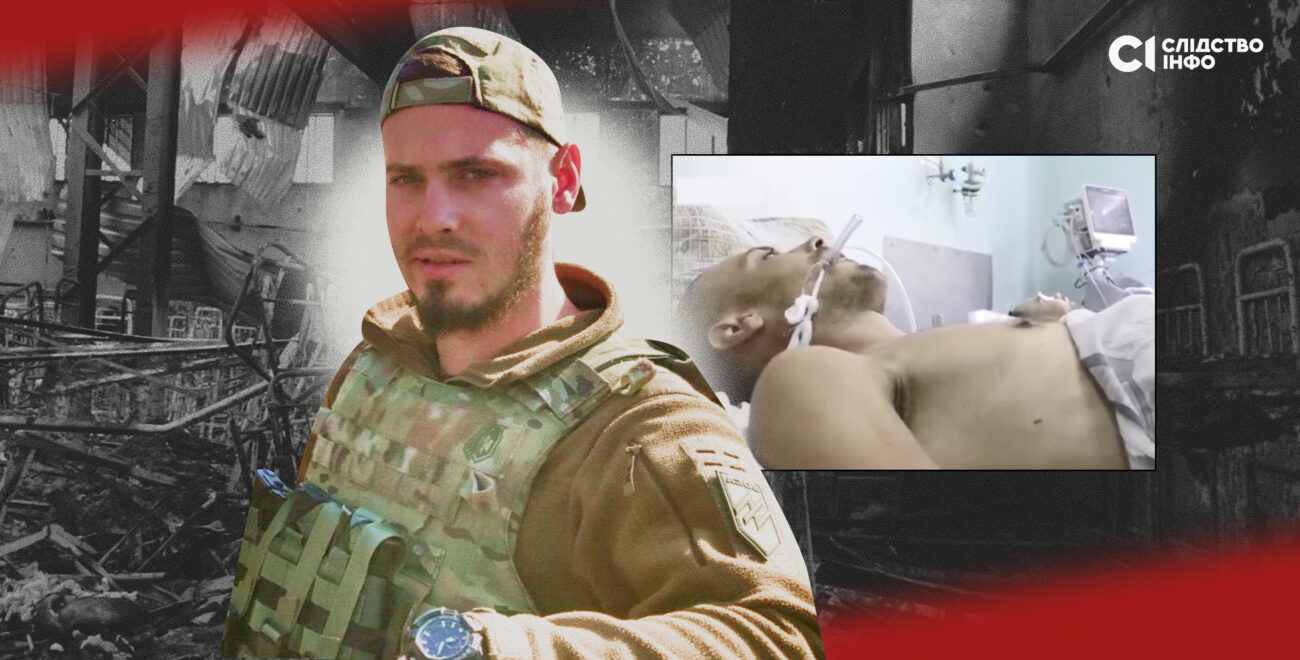
"I'm walking, my blood is splashing in my boots." "Azov" could have died in captivity three times
Source: SlidstvoInfo
Author: Karina Bugaychenko
“Azov” fighter Oleksandr Verengotov, known by the call sign “Malik,” survived a terrorist attack in “Barrack 200” in Olenivka; in Taganrog, his nose, a rib, and an arm were broken; and in Kamyshin, his leg was broken
“Azov” fighter Oleksandr Verengotov, known by the alias “Malik,” arrived from Berdiansk to defend Mariupol in the early days of the full-scale invasion. He established communications in the Azovstal bunkers, and after his commander was killed, he took his place. When he surrendered as a prisoner of honor, he had no idea that he would not see his young children and wife again for three years. “Malik” had to endure: a terrorist attack in “Barrack 200” in Olenivka; in Taganrog, his nose, a rib, and an arm were broken; in Kamyshin, his leg was broken. Journalists from “Slidstvo.Info” identified those who tormented Oleksandr and the other Ukrainian soldiers in captivity.
This is detailed in the “Slidstvo.Info” article “People Were Shocked with Stun Guns”: Who Is Torturing “Azov” Soldiers in Captivity.
For English subtitles, please enable captions in the video settings and select Auto-translate → English.
Author: Karina Bugaychenko
“Azov” fighter Oleksandr Verengotov, known by the call sign “Malik,” survived a terrorist attack in “Barrack 200” in Olenivka; in Taganrog, his nose, a rib, and an arm were broken; and in Kamyshin, his leg was broken
“Azov” fighter Oleksandr Verengotov, known by the alias “Malik,” arrived from Berdiansk to defend Mariupol in the early days of the full-scale invasion. He established communications in the Azovstal bunkers, and after his commander was killed, he took his place. When he surrendered as a prisoner of honor, he had no idea that he would not see his young children and wife again for three years. “Malik” had to endure: a terrorist attack in “Barrack 200” in Olenivka; in Taganrog, his nose, a rib, and an arm were broken; in Kamyshin, his leg was broken. Journalists from “Slidstvo.Info” identified those who tormented Oleksandr and the other Ukrainian soldiers in captivity.
This is detailed in the “Slidstvo.Info” article “People Were Shocked with Stun Guns”: Who Is Torturing “Azov” Soldiers in Captivity.
For English subtitles, please enable captions in the video settings and select Auto-translate → English.
“I WAS PREPARED TO DIE AT ANY MOMENT”
“It’s strange to see so much light. Since returning from captivity, I’ve been wearing dark glasses almost everywhere,” says soldier Oleksandr Verengotov.
Oleksandr is 33 years old and has served in the military for 10 of those years. As soon as he was discharged at the end of his contract and began civilian life, Russia’s full-scale invasion began.
“Malik” called his unit commander, and on February 27, 2022, he was already heading to Azovstal to set up a command post and establish radio and internet communications. At the time, Oleksandr’s wife Sofia, their three-year-old daughter, and six-month-old son remained at home in Berdiansk.
“I hugged and kissed my family and left. My wife is a very intelligent and calm woman; she understood me right away—she chose a soldier herself. And in Mariupol, I was doing my job; it was as if my emotions were turned off. Every day you see death, blood, destruction, shelling. I didn’t even think about being taken prisoner,” recalls Azov soldier Oleksandr Verengotov.
At times, it seemed to Oleksandr that he would never return home from Mariupol.
“I had internet and was in touch with my wife, but I didn’t even want to talk. She asked me, ‘What’s going on with you? You’re not yourself at all—talk to me, give me some guidance.’ To which I replied, ‘Go ahead, start forgetting about me little by little, because soon I won’t be here anymore; get used to living without me. Find a decent father for the kids so everything will be okay.” I was already preparing myself for the fact that I’d die any day now. To which my wife gave me a good scolding, “snapped me out of it,” and made me promise then and there that I’d survive, that I’d come back. And that promise of mine kept me from giving up; I remembered our conversation every day. I held on, and it’s all thanks to my wife,” says Oleksandr.
On the command of their superiors, the defenders of Azovstal—among whom was the soldier “Malik”—surrendered honorably. That’s how he first ended up in Olenivka, in the Donetsk region. He was placed there with his comrades, among whom was Dmytro Kozatskyi “Orest”: “We were together in Olenivka, and ‘Malik’ was a very important source of support for me. We constantly dreamed and talked about what we would do after the exchange. We’ve been friends for a long time, and it’s easy for us to talk without holding anything back. But when they took him to ‘Barrack 200,’ it was a tragedy for me. There was no information at all—whether he was alive or not.”
On July 27, 2022, in Olenivka, prison staff selectively took soldiers from the Mariupol garrison out of the barracks and transferred them to the industrial zone, into a hangar. It was nicknamed “Barrack 200” because that was supposed to be the number of prisoners of war held there.
“We went to sleep. I heard an explosion. I opened my eyes, looked around: it had exploded, so it had exploded. We were already used to this; after Azovstal, it didn’t surprise us. And then another explosion. I threw off my sleeping bag—I’d been sleeping in shorts—and looked at myself: I was covered in blood too,” says “Malik.”
Some of the prisoners of war were screaming in confusion, not understanding what was happening; others had been wounded. Prisoners lay there without limbs, completely mangled. Oleksandr tried to make his way to the hangar exit; he stepped over the bodies, the severed arms and legs of his comrades. He himself had trouble breathing; blood was streaming down his left side.
He adds: “I saw my comrade’s head as I was moving toward the exit. Right next to the hangar, they were already stacking the dead; all the wounded sat there for another three or four hours. We were waiting for the evacuation to the hospital that had been promised, but many didn’t make it—the guys bled out. They lay there, writhing, writhing in pain, screaming, begging for help, but the Russian Federation didn’t hear them and didn’t want to hear them. I’m sitting here thinking that my time will come soon too.”
It was already beginning to get light when the wounded from the terrorist attack in Olenivka were brought to a hospital in Donetsk. On the way, a young man with a bullet hole in his head died in Oleksandr’s arms—the wound was so severe that his brain was visible. “Malik” covered the hole with his hands, but it was no use; he didn’t make it.
“I was wearing my combat boots—those ‘lucky’ ones of ours—and they were completely soaked in blood. Damn, it was almost funny to me; I don’t know. The hospital had these white tiles, and I was walking around splattering my own blood everywhere. I opened my eyes in the ICU. And this woman says: ‘This guy’ (pointing at me), I don’t know how he survived at all. It’s not like he was born in a shirt—he was born in a spacesuit; he lost over 2.5 liters of blood.’ They removed my spleen. They removed the shrapnel, but, as it turned out, not all of it,” says Oleksandr.
Oleksandr’s wife found footage from the Donetsk hospital where her husband was being treated in propaganda posts. She saw Oleksandr and was convinced he had survived. But that was practically the only information she had for the next two years. Sofia wrote two letters to her beloved in captivity, enclosing photos of their children. But her husband never received them.
“THEY GOT A KICK OUT OF TORTURING US”
In late September 2022, Oleksandr was transferred to Taganrog. During the initial screening, the prisoner of war was maimed: “The intake process in Taganrog was brutal. They broke my nose, smashed my head, and fractured my ribs—no medical care was provided. According to unconfirmed reports, nine prisoners of war died during the ‘intake’ of our first group.”
Taganrog Pretrial Detention Center No. 2 is considered one of Russia’s most brutal and secretive torture chambers, operated under the supervision of the FSB. The Russians held the captured journalist Viktoria Roshchina in this detention center, and one of the women released from captivity, Inga Chekinda, told “Slidstvo.Info” that her sister had been shoved into an oven there.
On June 30, 2023, Oleksandr Verengotov was transferred to a detention center in the city of Kamyshin, Volgograd Oblast. He was held there until his release in March 2025. During the inspection of the prisoners of war, they were beaten again. Oleksandr recalls: “I said to one officer: ‘Sir, after a shrapnel wound to the abdomen, if possible, not to the stomach.’ He asked: ‘What about the head?’ I said: ‘Everything’s fine with the head.’ And he said: ‘Well, then—on the head.’ I thought to myself: ‘Thanks for asking.’
Unlike the prison in Taganrog, in Kamyshin there was a radio and a video camera mounted on the wall. This way, the guards could watch the prisoners, hear them, and give orders. On the first morning, the prisoners woke up to the Russian national anthem, and they were forced to sing it. But almost immediately, we found ourselves in the hallway; the guards didn’t like the performance and started beating the prisoners with batons and their feet.
“There was a torture chamber above our cell. There, our guys were tortured around the clock. 24/7 you hear the screams of your comrades and wait for your turn to come. Eventually, I ended up in that torture chamber too. They attached wires to my body, ran electricity through me, and put a bag over my head. You lie on your stomach with your hands and feet tied; they conducted the interrogation in that position. “Tell us who you killed among the civilians in Mariupol, how the drama theater was bombed, which foreign instructors you know,” one of the guards says to me, while another turns the device that delivers the electric current—we called it a “tapik.” “This could go on for hours; they got a kick out of torturing us,” says Oleksandr.
During his first month in the Kamyshin pretrial detention center, a prison guard broke Oleksandr’s leg. He was “fond of breaking bones,” recalls the man released from captivity. Once, this prison guard thought the man had raised his head higher than allowed while in a bent position, so he beat him with whatever came to hand and broke his leg. In addition, the bathhouse attendant would hold a stun gun up to the prisoners’ wet bodies: “He really loved to shock people with it. You end up smelling like a roasted chicken. And he got pleasure out of it—he wasn’t a human being, but some kind of sadist.”
After Oleksandr’s leg was broken, he was taken to the medical station every day for over a month—they applied a bandage that would later slip off, and smeared the wounds with green antiseptic. They didn’t give the prisoner crutches; he says: “You crawl on all fours, special forces escort you, and if I turn my head the wrong way, I get hit in the ribs.”
Journalists from “Slidstvo.Info” tracked down employees of this detention facility, analyzed their social media pages and financial records. The guards post photos with their families and take out microloans, yet there is not a word about the war crimes in which they are likely implicated.
“MY SOUL WAS TEARING APART”: RETURNING HOME
Oleksandr Verengotov said that a few years before the Ukrainian soldiers were detained at Pretrial Detention Center No. 2 in Kamyshin, representatives of the Red Cross and human rights activists visited once, while the regional Russian prosecutor showed up almost every week. However, this did not change the situation—the prisoners were unable to report the constant torture. Instead, during the exchange on March 19, 2025, Oleksandr noticed the Russian prisoners; he says they were of normal weight and well-dressed, and they did not look as battered as the released Ukrainians.
When “Malik” saw the Ukrainian flag and the word “Ukraine,” tears streamed down his face.
“My family kept me going all those years in captivity. When I returned to my homeland, I was overwhelmed with emotions: whether it was sadness, anger, or love. My heart was breaking when I first saw my wife and children. I hugged them then and simply lost my voice. I felt so at peace that we had finally reunited. I kept my promise to return,” Alexander shares.
His wife, Sofia, had spent all those years waiting for any news about her beloved. She comforted herself with the thought that millions of Ukrainians were enduring similar uncertainty and that she just had to wait a little longer. And when she found out that her husband had been exchanged, she says she became happy again.
“I felt like I came back to life; I started breathing normally, and my thoughts became clear. I remember just smiling all night after that joyful news. We finally have a complete family again; the children have a father, and he’s alive. I noticed that Sasha’s voice had deepened, and in his manner he had become such a gentle man—loving and beloved,” says his wife Sofia with a smile on her lips, wiping away tears of happiness.
Alexander admits that adapting to the free environment in the first weeks after the exchange was difficult. So many new people, the light, so much open space—I had to think through my sentences in my head before speaking, and I still got confused.
“I can’t watch movies, but I listen to Ukrainian music at every opportunity. I have an aversion to the Russian language. I walk into a place and hear someone at the next table speaking Russian, and it just makes me furious. Why? Still? How is this happening?” Alexander says.
On the other hand, “Malik” is pleasantly impressed by the weekly protests calling for the release of prisoners. From the very first weeks after his release, he has tried to attend them with his comrades; he became friends with some of them while still in Russian prisons.
“If those who are currently in captivity at least knew that they are remembered here, loved, and awaited—it would give the guys strength. Because many of them there have already lost hope. They think they fought in Mariupol, that they’ve performed heroic deeds, but that it’s all been forgotten, that nobody needs them there anymore. I go to these rallies because the people who are in captivity have done so much for our country, and we must not forget them,” says Oleksandr Verengotov.
“It’s strange to see so much light. Since returning from captivity, I’ve been wearing dark glasses almost everywhere,” says soldier Oleksandr Verengotov.
Oleksandr is 33 years old and has served in the military for 10 of those years. As soon as he was discharged at the end of his contract and began civilian life, Russia’s full-scale invasion began.
“Malik” called his unit commander, and on February 27, 2022, he was already heading to Azovstal to set up a command post and establish radio and internet communications. At the time, Oleksandr’s wife Sofia, their three-year-old daughter, and six-month-old son remained at home in Berdiansk.
“I hugged and kissed my family and left. My wife is a very intelligent and calm woman; she understood me right away—she chose a soldier herself. And in Mariupol, I was doing my job; it was as if my emotions were turned off. Every day you see death, blood, destruction, shelling. I didn’t even think about being taken prisoner,” recalls Azov soldier Oleksandr Verengotov.
At times, it seemed to Oleksandr that he would never return home from Mariupol.
“I had internet and was in touch with my wife, but I didn’t even want to talk. She asked me, ‘What’s going on with you? You’re not yourself at all—talk to me, give me some guidance.’ To which I replied, ‘Go ahead, start forgetting about me little by little, because soon I won’t be here anymore; get used to living without me. Find a decent father for the kids so everything will be okay.” I was already preparing myself for the fact that I’d die any day now. To which my wife gave me a good scolding, “snapped me out of it,” and made me promise then and there that I’d survive, that I’d come back. And that promise of mine kept me from giving up; I remembered our conversation every day. I held on, and it’s all thanks to my wife,” says Oleksandr.
On the command of their superiors, the defenders of Azovstal—among whom was the soldier “Malik”—surrendered honorably. That’s how he first ended up in Olenivka, in the Donetsk region. He was placed there with his comrades, among whom was Dmytro Kozatskyi “Orest”: “We were together in Olenivka, and ‘Malik’ was a very important source of support for me. We constantly dreamed and talked about what we would do after the exchange. We’ve been friends for a long time, and it’s easy for us to talk without holding anything back. But when they took him to ‘Barrack 200,’ it was a tragedy for me. There was no information at all—whether he was alive or not.”
On July 27, 2022, in Olenivka, prison staff selectively took soldiers from the Mariupol garrison out of the barracks and transferred them to the industrial zone, into a hangar. It was nicknamed “Barrack 200” because that was supposed to be the number of prisoners of war held there.
“We went to sleep. I heard an explosion. I opened my eyes, looked around: it had exploded, so it had exploded. We were already used to this; after Azovstal, it didn’t surprise us. And then another explosion. I threw off my sleeping bag—I’d been sleeping in shorts—and looked at myself: I was covered in blood too,” says “Malik.”
Some of the prisoners of war were screaming in confusion, not understanding what was happening; others had been wounded. Prisoners lay there without limbs, completely mangled. Oleksandr tried to make his way to the hangar exit; he stepped over the bodies, the severed arms and legs of his comrades. He himself had trouble breathing; blood was streaming down his left side.
He adds: “I saw my comrade’s head as I was moving toward the exit. Right next to the hangar, they were already stacking the dead; all the wounded sat there for another three or four hours. We were waiting for the evacuation to the hospital that had been promised, but many didn’t make it—the guys bled out. They lay there, writhing, writhing in pain, screaming, begging for help, but the Russian Federation didn’t hear them and didn’t want to hear them. I’m sitting here thinking that my time will come soon too.”
It was already beginning to get light when the wounded from the terrorist attack in Olenivka were brought to a hospital in Donetsk. On the way, a young man with a bullet hole in his head died in Oleksandr’s arms—the wound was so severe that his brain was visible. “Malik” covered the hole with his hands, but it was no use; he didn’t make it.
“I was wearing my combat boots—those ‘lucky’ ones of ours—and they were completely soaked in blood. Damn, it was almost funny to me; I don’t know. The hospital had these white tiles, and I was walking around splattering my own blood everywhere. I opened my eyes in the ICU. And this woman says: ‘This guy’ (pointing at me), I don’t know how he survived at all. It’s not like he was born in a shirt—he was born in a spacesuit; he lost over 2.5 liters of blood.’ They removed my spleen. They removed the shrapnel, but, as it turned out, not all of it,” says Oleksandr.
Oleksandr’s wife found footage from the Donetsk hospital where her husband was being treated in propaganda posts. She saw Oleksandr and was convinced he had survived. But that was practically the only information she had for the next two years. Sofia wrote two letters to her beloved in captivity, enclosing photos of their children. But her husband never received them.
“THEY GOT A KICK OUT OF TORTURING US”
In late September 2022, Oleksandr was transferred to Taganrog. During the initial screening, the prisoner of war was maimed: “The intake process in Taganrog was brutal. They broke my nose, smashed my head, and fractured my ribs—no medical care was provided. According to unconfirmed reports, nine prisoners of war died during the ‘intake’ of our first group.”
Taganrog Pretrial Detention Center No. 2 is considered one of Russia’s most brutal and secretive torture chambers, operated under the supervision of the FSB. The Russians held the captured journalist Viktoria Roshchina in this detention center, and one of the women released from captivity, Inga Chekinda, told “Slidstvo.Info” that her sister had been shoved into an oven there.
On June 30, 2023, Oleksandr Verengotov was transferred to a detention center in the city of Kamyshin, Volgograd Oblast. He was held there until his release in March 2025. During the inspection of the prisoners of war, they were beaten again. Oleksandr recalls: “I said to one officer: ‘Sir, after a shrapnel wound to the abdomen, if possible, not to the stomach.’ He asked: ‘What about the head?’ I said: ‘Everything’s fine with the head.’ And he said: ‘Well, then—on the head.’ I thought to myself: ‘Thanks for asking.’
Unlike the prison in Taganrog, in Kamyshin there was a radio and a video camera mounted on the wall. This way, the guards could watch the prisoners, hear them, and give orders. On the first morning, the prisoners woke up to the Russian national anthem, and they were forced to sing it. But almost immediately, we found ourselves in the hallway; the guards didn’t like the performance and started beating the prisoners with batons and their feet.
“There was a torture chamber above our cell. There, our guys were tortured around the clock. 24/7 you hear the screams of your comrades and wait for your turn to come. Eventually, I ended up in that torture chamber too. They attached wires to my body, ran electricity through me, and put a bag over my head. You lie on your stomach with your hands and feet tied; they conducted the interrogation in that position. “Tell us who you killed among the civilians in Mariupol, how the drama theater was bombed, which foreign instructors you know,” one of the guards says to me, while another turns the device that delivers the electric current—we called it a “tapik.” “This could go on for hours; they got a kick out of torturing us,” says Oleksandr.
During his first month in the Kamyshin pretrial detention center, a prison guard broke Oleksandr’s leg. He was “fond of breaking bones,” recalls the man released from captivity. Once, this prison guard thought the man had raised his head higher than allowed while in a bent position, so he beat him with whatever came to hand and broke his leg. In addition, the bathhouse attendant would hold a stun gun up to the prisoners’ wet bodies: “He really loved to shock people with it. You end up smelling like a roasted chicken. And he got pleasure out of it—he wasn’t a human being, but some kind of sadist.”
After Oleksandr’s leg was broken, he was taken to the medical station every day for over a month—they applied a bandage that would later slip off, and smeared the wounds with green antiseptic. They didn’t give the prisoner crutches; he says: “You crawl on all fours, special forces escort you, and if I turn my head the wrong way, I get hit in the ribs.”
Journalists from “Slidstvo.Info” tracked down employees of this detention facility, analyzed their social media pages and financial records. The guards post photos with their families and take out microloans, yet there is not a word about the war crimes in which they are likely implicated.
“MY SOUL WAS TEARING APART”: RETURNING HOME
Oleksandr Verengotov said that a few years before the Ukrainian soldiers were detained at Pretrial Detention Center No. 2 in Kamyshin, representatives of the Red Cross and human rights activists visited once, while the regional Russian prosecutor showed up almost every week. However, this did not change the situation—the prisoners were unable to report the constant torture. Instead, during the exchange on March 19, 2025, Oleksandr noticed the Russian prisoners; he says they were of normal weight and well-dressed, and they did not look as battered as the released Ukrainians.
When “Malik” saw the Ukrainian flag and the word “Ukraine,” tears streamed down his face.
“My family kept me going all those years in captivity. When I returned to my homeland, I was overwhelmed with emotions: whether it was sadness, anger, or love. My heart was breaking when I first saw my wife and children. I hugged them then and simply lost my voice. I felt so at peace that we had finally reunited. I kept my promise to return,” Alexander shares.
His wife, Sofia, had spent all those years waiting for any news about her beloved. She comforted herself with the thought that millions of Ukrainians were enduring similar uncertainty and that she just had to wait a little longer. And when she found out that her husband had been exchanged, she says she became happy again.
“I felt like I came back to life; I started breathing normally, and my thoughts became clear. I remember just smiling all night after that joyful news. We finally have a complete family again; the children have a father, and he’s alive. I noticed that Sasha’s voice had deepened, and in his manner he had become such a gentle man—loving and beloved,” says his wife Sofia with a smile on her lips, wiping away tears of happiness.
Alexander admits that adapting to the free environment in the first weeks after the exchange was difficult. So many new people, the light, so much open space—I had to think through my sentences in my head before speaking, and I still got confused.
“I can’t watch movies, but I listen to Ukrainian music at every opportunity. I have an aversion to the Russian language. I walk into a place and hear someone at the next table speaking Russian, and it just makes me furious. Why? Still? How is this happening?” Alexander says.
On the other hand, “Malik” is pleasantly impressed by the weekly protests calling for the release of prisoners. From the very first weeks after his release, he has tried to attend them with his comrades; he became friends with some of them while still in Russian prisons.
“If those who are currently in captivity at least knew that they are remembered here, loved, and awaited—it would give the guys strength. Because many of them there have already lost hope. They think they fought in Mariupol, that they’ve performed heroic deeds, but that it’s all been forgotten, that nobody needs them there anymore. I go to these rallies because the people who are in captivity have done so much for our country, and we must not forget them,” says Oleksandr Verengotov.
This is an automatic translation generated by DeepL.