"I died in that torture chamber": The story of a Kherson man
Source: Ukrinform
Author: Anna Bodrova
The invaders held Igor Bondarenko in a torture chamber for 15 days, subjecting him to electric shocks and starvation in an attempt to force him to work for Russia
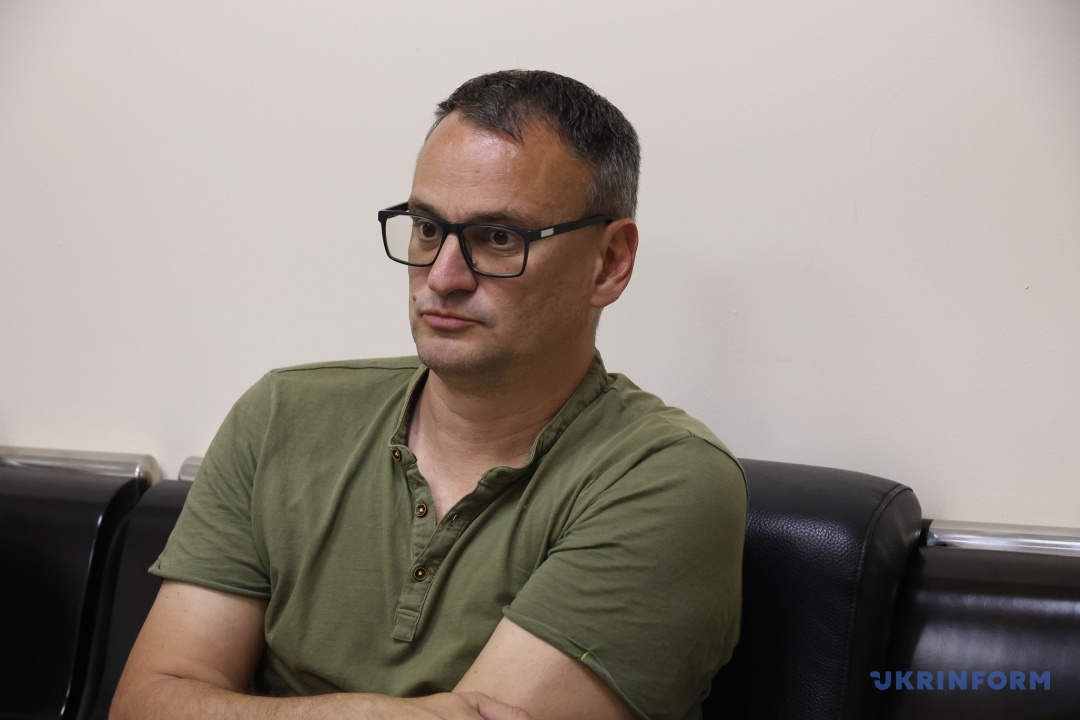
Igor Bondarenko is 47 years old. Until 2017, he worked as a journalist for Radio Sofia in Kherson, as an editor for the Black Sea TV and Radio Company (relocated from Crimea), and acted in films. Igor Bondarenko told Ukrinform about how he became a victim of modern slavery and about Russian torture.
Ihor says that he used to be involved in anti-corruption journalism and came into contact with figures who are now “well-known” in Kherson and beyond.
- There are people who support Ukraine. There are those who support Russia. And there are those who are in it for the money. Saldo, Semenchev, and Stremousov—they fall into this category. They asked me to work for them, but I refused,” he recalls.
He continues that his family needed money, so he went to Poland to work. There he worked as a truck driver, and in December 2021 he returned to Kherson due to health issues.
- For a long time I didn’t know about the illness; it was asymptomatic. Then I was enrolled in a free government treatment program and had to submit a set of lab tests. I just had one final exam left when the occupation began. Sometime in March, a hepatologist from our infectious disease hospital called and said I could get medication. I went straight to the hospital, but on the way, a medical worker called me and warned that the FSB was interested in me and that their people were waiting for me. Two weeks later, that same doctor secretly handed me the medication,” Bondarenko says.
The treatment course lasted 84 days; during this time, Ihor decided to stay in Kherson: he was worried that his medication might be confiscated at checkpoints if he left. When asked how he lived under occupation, he replies sadly: “I was hiding.”
- I had some savings that allowed me to survive. I learned to be invisible. I only moved around through courtyards. Activist friends warned me that I needed to leave, but I hoped the Russians would leave Kherson. At first, I even went to rallies—it was hard to spot me in the crowd. But when people started disappearing in the city and bodies were found in the forest, it became clear that the Russians weren’t joking,” the man recalls.
After finishing his treatment, Igor began preparing to leave. His wife and son were the first to leave Kherson.
- I was afraid they might be detained along with me. When my family reached Germany, I decided to leave. I prepared thoroughly: I wiped my phone clean, deleting all numbers and photos that might attract the Russians’ attention. It was August 10. I passed through several checkpoints without incident, but in Kalanchak, they took my phone and documents. They led me into a small trailer and ordered me to wait. An FSB officer came in. His first question was: “Who is Natalia Voteichkina?” She’s my neighbor on the third floor, the leader of the “Right Sector” in Kherson. That’s when I realized I was in trouble,” he continues.
Then they started intimidating him: “You’ll go to Simferopol—and you’ll disappear there forever.” Eventually, they took him to a steel container where two men were already sitting—they had been detained because of photos of the Ukrainian flag found on their phones.
- During the day, the container heated up so much in the sun that it was impossible to breathe. At night, on the other hand, it was very cold—like in a freezer. They didn’t even give me water. In the morning, they took me out onto the road and told me I was banned from entering Russian territory. They put me in a “minibus” with the letter Z on it, threw a rag over my head, tied my hands, and drove me off in an unknown direction,” he says.
After about 40 minutes of “travel,” the bus stopped, and Igor was led outside.
“When they removed the cloth from my face, I immediately realized I was in the Kherson region, not in Crimea. They led me about 50 meters and stopped near a pit about four meters long. There were bodies lying there. They asked me if I wanted to join them. I replied that I didn’t want to. Then a shot rang out above my head, and one of the Russians struck me in the back with the butt of his rifle with all his might. I fell, and the Russians started laughing: “At least you didn’t shit yourself.” But I had nothing left—all the water had come out with my sweat in that container,” recalls Ihor.
After that, they covered his face again and took him further by bus. An hour later, the occupiers brought the man to their base. They led him to a guardhouse that served as their torture chamber.
- They chained me to a stove. I lay on my left side the whole time on old tile. It was cold; ever since then, I’ve had problems with my back and my left arm. They interrogated me for four days, and for four nights they tortured and humiliated me with the worst kind of words. They asked the same questions over and over: which activists I knew, who was still in the city, where to find them, and how long I’d been working for the SBU. One torturer kept repeating that he had been “fighting the ‘Right Sector’ in Donbas since 2014” and that’s why he was going to maim me now. The whole time, I was chained to the stove. On the second day, they added electric shocks to the beatings. They shock you in the back—you fall forward, and at that moment they kick you in the stomach. It’s violence for the sake of violence. They didn’t give me anything to eat for five days; they only brought me a half-liter bottle of water. They also broke a mop on me and tried to rape me with the broken piece. I started bleeding, and my shorts stuck to my body. “When they took me to the bathroom and I tried to take them off, it felt like I was peeling off my scalp,” says Igor.
Igor explained to the Russians that he had no connection to Ukrainian activists or the security services. That he had been a journalist for a long time, but in recent years had worked as a long-haul truck driver.
They kept him separate from the others, but he constantly heard the prisoners’ screams during interrogations.
“I was alone, with no one to talk to. Back then, my mind worked like a computer: if you pass the test, you come out alive; if you don’t, you lose. The hardest part was the bathroom. I had to bang on the door and ask to be let out. Sometimes the guard wouldn’t let me out—I had to relieve myself in the corner. In the morning, they forced me to clean it up with my hands. And then—to eat with those same hands,” he says.
The torture stopped on August 16.
“I was ordered to work for the Russians—to run a propaganda Telegram channel. If I refused, they said I’d end up in the pit of corpses I’d seen five days earlier,” says Igor.
According to him, he was then forced to agree. He was given a cell phone and created the channel. He says the subscribers were all “fake bots.”
“On August 17, I found out they were looking for me. A post appeared on the “Most” website saying that I had been kidnapped,” Igor said.
That same day, the man got in touch with his family. He sent encrypted emails to his wife and sister. The letters mentioned places and events that no one else knew about.
- Based on the geolocation, I found out that I was in Skadovsk. I wrote my sister a childhood memory: when I was visiting them, I recalled the warm sea. That’s how I let her know I was alive,” he explained.
Igor was released on August 25. The Russians took him to a bus stop and left him there. He traveled to Hola Prystan, and from there made his way to Kherson by motorboat. A new handler was waiting for him in the city to oversee the channel’s operations.
- He contacted me on September 2. Until then, I had been reporting my location to the “captain” in Skadovsk. The supervisor was a young guy, some “spoiled” son of an FSB officer. He showed up to the meeting high, “catching up” with tea. As I understand it, he blew all the money he was allocated from above to run the network on drugs. He wasn’t interested in my work,” Bondarenko says.
When Kherson was liberated, the man immediately went to the police. Until then, he had officially been considered missing.
Time passed, and unable to find work in Kherson, Igor decided to temporarily move to Odesa, where he got a job as a driver on international routes.
“Last summer, I was granted civilian prisoner of war status and sent to a hospital. Such a list of illnesses… Diffuse changes in the liver and pancreas, numerous hernias along my back, nerve compression, osteochondrosis. I also started having memory problems. Sometimes it’s as if I “black out” for a while; I can’t remember what I was doing 10 minutes ago. Eventually, I underwent a medical examination and was granted a third-degree disability, he says.
His health was deteriorating, and he lost his job as a driver. He then turned to the Caritas charity for help, having heard about it from friends.
According to Igor Bondarenko, he only learned last summer that he had been a victim of human trafficking and sexual violence. He underwent a series of consultations with a psychologist and recently, with the foundation’s help, obtained the status of a victim of human trafficking. He notes that he will now be able to receive financial assistance.
- It’s impossible to completely change your life in just six sessions. But the most important thing is that the psychologist advised me to talk more about what I went through, to let the pain out. That’s why I’m talking to you now. I didn’t talk about sexual violence before. Now I can talk about it because it’s become easier for me. The psychologist explained that the key to my recovery is staying busy. Yes, because of my back problems, I can’t work as a driver, but in Odesa, there are plenty of people who can’t even fix a light socket. I posted an ad online offering help with household chores, and I’m already seeing results. I’m gradually earning money for my treatment,” the man shares.
He notes: if it weren’t for the difficult financial situation, he probably wouldn’t have sought help from specialists.
- In our prisoner support group, “Prisoners of Kherson,” they say: “You crawled out alive—and thank God.” Our perception of the world has changed. I have a friend who still lives in Kherson. He was held captive for eight days. I don’t know what they did to him there, but at 50, he looks 70. I ask him if he’s received official recognition or reported it to the police. But he says he doesn’t want to and adds that he’ll make a living on his own. People don’t want to talk. Another friend of mine volunteered for the Armed Forces of Ukraine after his captivity. He died three months later. He strapped grenades to himself and jumped into a Russian trench on the left bank. A young guy. When we went through the medical board together, he said he wanted to kill them all.
He notes: not everyone can admit that at some point they were weak.
“I died in captivity, and a different person came out of it. Sometimes it feels like they shot me right there by that pit of corpses, and now someone else is living. Or that this is some kind of purgatory,” says Ihor.
He adds that he doesn’t make plans more than a day in advance, but he tries not to lose his optimism.
“Go to Kherson if you don’t understand why. We say this: ‘I woke up in the morning, made it to lunchtime, and thank God.’” People live one day at a time. You could die at any moment. But I have a dream. I want to take my daughter, who currently lives in Ivano-Frankivsk, to visit her sister in Italy. Part of me wants to leave Ukraine for good, but another part says that if I do, I’ll be betraying my country and looking like a deserter. And so I stay,” says Igor.
Igor’s story is a testament to how deep human pain can be, and at the same time, proof that a return to life is possible—it begins with acknowledging the trauma and seeking help.
The project aimed at supporting victims of human trafficking continues at Caritas. The foundation urges people to reach out to them. They say that victims undergo an assessment of their needs, and individual reintegration plans are developed for them; they receive psychological or psychotherapeutic assistance, as well as social, legal, and material services, support in finding work, and more.
- There are many people who simply do not know or do not understand that they can take advantage of such assistance because they do not consider themselves victims of human trafficking. People who have experienced traumatic events need to be told exactly what happened to them and guided in their next steps. Unfortunately, we cannot help everyone who has returned from captivity. In our project, it is essential that the person has experienced labor exploitation. Intellectual exploitation, as in the case of Mr. Igor, also falls under this definition, since it is forced, coercive exploitation,” says Svitlana Kolodchyn, project manager at the Caritas Odessa UGCC Charitable Foundation.
According to the foundation, internal human trafficking increased significantly during the full-scale invasion. Based solely on official statistics provided by the State Social Service, 347 people fell victim to human trafficking between 2022 and 2024. The foundation reports that in the first quarter of 2025, there were already “56 identified cases of human trafficking and 39 cases of conflict-related sexual violence.” Over 70% of the victims fell prey to mixed forms of exploitation, most often while in captivity. They were sexually exploited, used as laborers or domestic servants, or forced to participate in military operations.
Anna Bodrova, Odessa
Author: Anna Bodrova
The invaders held Igor Bondarenko in a torture chamber for 15 days, subjecting him to electric shocks and starvation in an attempt to force him to work for Russia
Igor Bondarenko is 47 years old. Until 2017, he worked as a journalist for Radio Sofia in Kherson, as an editor for the Black Sea TV and Radio Company (relocated from Crimea), and acted in films. Igor Bondarenko told Ukrinform about how he became a victim of modern slavery and about Russian torture.
“UNDER OCCUPATION, I LEARNED TO BE AN INVISIBLE PERSON”
Ihor says that he used to be involved in anti-corruption journalism and came into contact with figures who are now “well-known” in Kherson and beyond.
- There are people who support Ukraine. There are those who support Russia. And there are those who are in it for the money. Saldo, Semenchev, and Stremousov—they fall into this category. They asked me to work for them, but I refused,” he recalls.
He continues that his family needed money, so he went to Poland to work. There he worked as a truck driver, and in December 2021 he returned to Kherson due to health issues.
- For a long time I didn’t know about the illness; it was asymptomatic. Then I was enrolled in a free government treatment program and had to submit a set of lab tests. I just had one final exam left when the occupation began. Sometime in March, a hepatologist from our infectious disease hospital called and said I could get medication. I went straight to the hospital, but on the way, a medical worker called me and warned that the FSB was interested in me and that their people were waiting for me. Two weeks later, that same doctor secretly handed me the medication,” Bondarenko says.
The treatment course lasted 84 days; during this time, Ihor decided to stay in Kherson: he was worried that his medication might be confiscated at checkpoints if he left. When asked how he lived under occupation, he replies sadly: “I was hiding.”
- I had some savings that allowed me to survive. I learned to be invisible. I only moved around through courtyards. Activist friends warned me that I needed to leave, but I hoped the Russians would leave Kherson. At first, I even went to rallies—it was hard to spot me in the crowd. But when people started disappearing in the city and bodies were found in the forest, it became clear that the Russians weren’t joking,” the man recalls.
After finishing his treatment, Igor began preparing to leave. His wife and son were the first to leave Kherson.
DEPARTURE AND DETENTION
- I was afraid they might be detained along with me. When my family reached Germany, I decided to leave. I prepared thoroughly: I wiped my phone clean, deleting all numbers and photos that might attract the Russians’ attention. It was August 10. I passed through several checkpoints without incident, but in Kalanchak, they took my phone and documents. They led me into a small trailer and ordered me to wait. An FSB officer came in. His first question was: “Who is Natalia Voteichkina?” She’s my neighbor on the third floor, the leader of the “Right Sector” in Kherson. That’s when I realized I was in trouble,” he continues.
Then they started intimidating him: “You’ll go to Simferopol—and you’ll disappear there forever.” Eventually, they took him to a steel container where two men were already sitting—they had been detained because of photos of the Ukrainian flag found on their phones.
- During the day, the container heated up so much in the sun that it was impossible to breathe. At night, on the other hand, it was very cold—like in a freezer. They didn’t even give me water. In the morning, they took me out onto the road and told me I was banned from entering Russian territory. They put me in a “minibus” with the letter Z on it, threw a rag over my head, tied my hands, and drove me off in an unknown direction,” he says.
After about 40 minutes of “travel,” the bus stopped, and Igor was led outside.
“When they removed the cloth from my face, I immediately realized I was in the Kherson region, not in Crimea. They led me about 50 meters and stopped near a pit about four meters long. There were bodies lying there. They asked me if I wanted to join them. I replied that I didn’t want to. Then a shot rang out above my head, and one of the Russians struck me in the back with the butt of his rifle with all his might. I fell, and the Russians started laughing: “At least you didn’t shit yourself.” But I had nothing left—all the water had come out with my sweat in that container,” recalls Ihor.
After that, they covered his face again and took him further by bus. An hour later, the occupiers brought the man to their base. They led him to a guardhouse that served as their torture chamber.
DAYTIME – INTERROGATIONS, NIGHTTIME – TORTURE
- They chained me to a stove. I lay on my left side the whole time on old tile. It was cold; ever since then, I’ve had problems with my back and my left arm. They interrogated me for four days, and for four nights they tortured and humiliated me with the worst kind of words. They asked the same questions over and over: which activists I knew, who was still in the city, where to find them, and how long I’d been working for the SBU. One torturer kept repeating that he had been “fighting the ‘Right Sector’ in Donbas since 2014” and that’s why he was going to maim me now. The whole time, I was chained to the stove. On the second day, they added electric shocks to the beatings. They shock you in the back—you fall forward, and at that moment they kick you in the stomach. It’s violence for the sake of violence. They didn’t give me anything to eat for five days; they only brought me a half-liter bottle of water. They also broke a mop on me and tried to rape me with the broken piece. I started bleeding, and my shorts stuck to my body. “When they took me to the bathroom and I tried to take them off, it felt like I was peeling off my scalp,” says Igor.
Igor explained to the Russians that he had no connection to Ukrainian activists or the security services. That he had been a journalist for a long time, but in recent years had worked as a long-haul truck driver.
They kept him separate from the others, but he constantly heard the prisoners’ screams during interrogations.
“I was alone, with no one to talk to. Back then, my mind worked like a computer: if you pass the test, you come out alive; if you don’t, you lose. The hardest part was the bathroom. I had to bang on the door and ask to be let out. Sometimes the guard wouldn’t let me out—I had to relieve myself in the corner. In the morning, they forced me to clean it up with my hands. And then—to eat with those same hands,” he says.
The torture stopped on August 16.
FORCED LABOR
“I was ordered to work for the Russians—to run a propaganda Telegram channel. If I refused, they said I’d end up in the pit of corpses I’d seen five days earlier,” says Igor.
According to him, he was then forced to agree. He was given a cell phone and created the channel. He says the subscribers were all “fake bots.”
“On August 17, I found out they were looking for me. A post appeared on the “Most” website saying that I had been kidnapped,” Igor said.
That same day, the man got in touch with his family. He sent encrypted emails to his wife and sister. The letters mentioned places and events that no one else knew about.
- Based on the geolocation, I found out that I was in Skadovsk. I wrote my sister a childhood memory: when I was visiting them, I recalled the warm sea. That’s how I let her know I was alive,” he explained.
Igor was released on August 25. The Russians took him to a bus stop and left him there. He traveled to Hola Prystan, and from there made his way to Kherson by motorboat. A new handler was waiting for him in the city to oversee the channel’s operations.
- He contacted me on September 2. Until then, I had been reporting my location to the “captain” in Skadovsk. The supervisor was a young guy, some “spoiled” son of an FSB officer. He showed up to the meeting high, “catching up” with tea. As I understand it, he blew all the money he was allocated from above to run the network on drugs. He wasn’t interested in my work,” Bondarenko says.
When Kherson was liberated, the man immediately went to the police. Until then, he had officially been considered missing.
LIFE AFTER TORTURE
Time passed, and unable to find work in Kherson, Igor decided to temporarily move to Odesa, where he got a job as a driver on international routes.
“Last summer, I was granted civilian prisoner of war status and sent to a hospital. Such a list of illnesses… Diffuse changes in the liver and pancreas, numerous hernias along my back, nerve compression, osteochondrosis. I also started having memory problems. Sometimes it’s as if I “black out” for a while; I can’t remember what I was doing 10 minutes ago. Eventually, I underwent a medical examination and was granted a third-degree disability, he says.
His health was deteriorating, and he lost his job as a driver. He then turned to the Caritas charity for help, having heard about it from friends.
According to Igor Bondarenko, he only learned last summer that he had been a victim of human trafficking and sexual violence. He underwent a series of consultations with a psychologist and recently, with the foundation’s help, obtained the status of a victim of human trafficking. He notes that he will now be able to receive financial assistance.
- It’s impossible to completely change your life in just six sessions. But the most important thing is that the psychologist advised me to talk more about what I went through, to let the pain out. That’s why I’m talking to you now. I didn’t talk about sexual violence before. Now I can talk about it because it’s become easier for me. The psychologist explained that the key to my recovery is staying busy. Yes, because of my back problems, I can’t work as a driver, but in Odesa, there are plenty of people who can’t even fix a light socket. I posted an ad online offering help with household chores, and I’m already seeing results. I’m gradually earning money for my treatment,” the man shares.
He notes: if it weren’t for the difficult financial situation, he probably wouldn’t have sought help from specialists.
- In our prisoner support group, “Prisoners of Kherson,” they say: “You crawled out alive—and thank God.” Our perception of the world has changed. I have a friend who still lives in Kherson. He was held captive for eight days. I don’t know what they did to him there, but at 50, he looks 70. I ask him if he’s received official recognition or reported it to the police. But he says he doesn’t want to and adds that he’ll make a living on his own. People don’t want to talk. Another friend of mine volunteered for the Armed Forces of Ukraine after his captivity. He died three months later. He strapped grenades to himself and jumped into a Russian trench on the left bank. A young guy. When we went through the medical board together, he said he wanted to kill them all.
He notes: not everyone can admit that at some point they were weak.
“I died in captivity, and a different person came out of it. Sometimes it feels like they shot me right there by that pit of corpses, and now someone else is living. Or that this is some kind of purgatory,” says Ihor.
He adds that he doesn’t make plans more than a day in advance, but he tries not to lose his optimism.
“Go to Kherson if you don’t understand why. We say this: ‘I woke up in the morning, made it to lunchtime, and thank God.’” People live one day at a time. You could die at any moment. But I have a dream. I want to take my daughter, who currently lives in Ivano-Frankivsk, to visit her sister in Italy. Part of me wants to leave Ukraine for good, but another part says that if I do, I’ll be betraying my country and looking like a deserter. And so I stay,” says Igor.
Igor’s story is a testament to how deep human pain can be, and at the same time, proof that a return to life is possible—it begins with acknowledging the trauma and seeking help.
The project aimed at supporting victims of human trafficking continues at Caritas. The foundation urges people to reach out to them. They say that victims undergo an assessment of their needs, and individual reintegration plans are developed for them; they receive psychological or psychotherapeutic assistance, as well as social, legal, and material services, support in finding work, and more.
- There are many people who simply do not know or do not understand that they can take advantage of such assistance because they do not consider themselves victims of human trafficking. People who have experienced traumatic events need to be told exactly what happened to them and guided in their next steps. Unfortunately, we cannot help everyone who has returned from captivity. In our project, it is essential that the person has experienced labor exploitation. Intellectual exploitation, as in the case of Mr. Igor, also falls under this definition, since it is forced, coercive exploitation,” says Svitlana Kolodchyn, project manager at the Caritas Odessa UGCC Charitable Foundation.
According to the foundation, internal human trafficking increased significantly during the full-scale invasion. Based solely on official statistics provided by the State Social Service, 347 people fell victim to human trafficking between 2022 and 2024. The foundation reports that in the first quarter of 2025, there were already “56 identified cases of human trafficking and 39 cases of conflict-related sexual violence.” Over 70% of the victims fell prey to mixed forms of exploitation, most often while in captivity. They were sexually exploited, used as laborers or domestic servants, or forced to participate in military operations.
Anna Bodrova, Odessa
This is an automatic translation generated by DeepL.