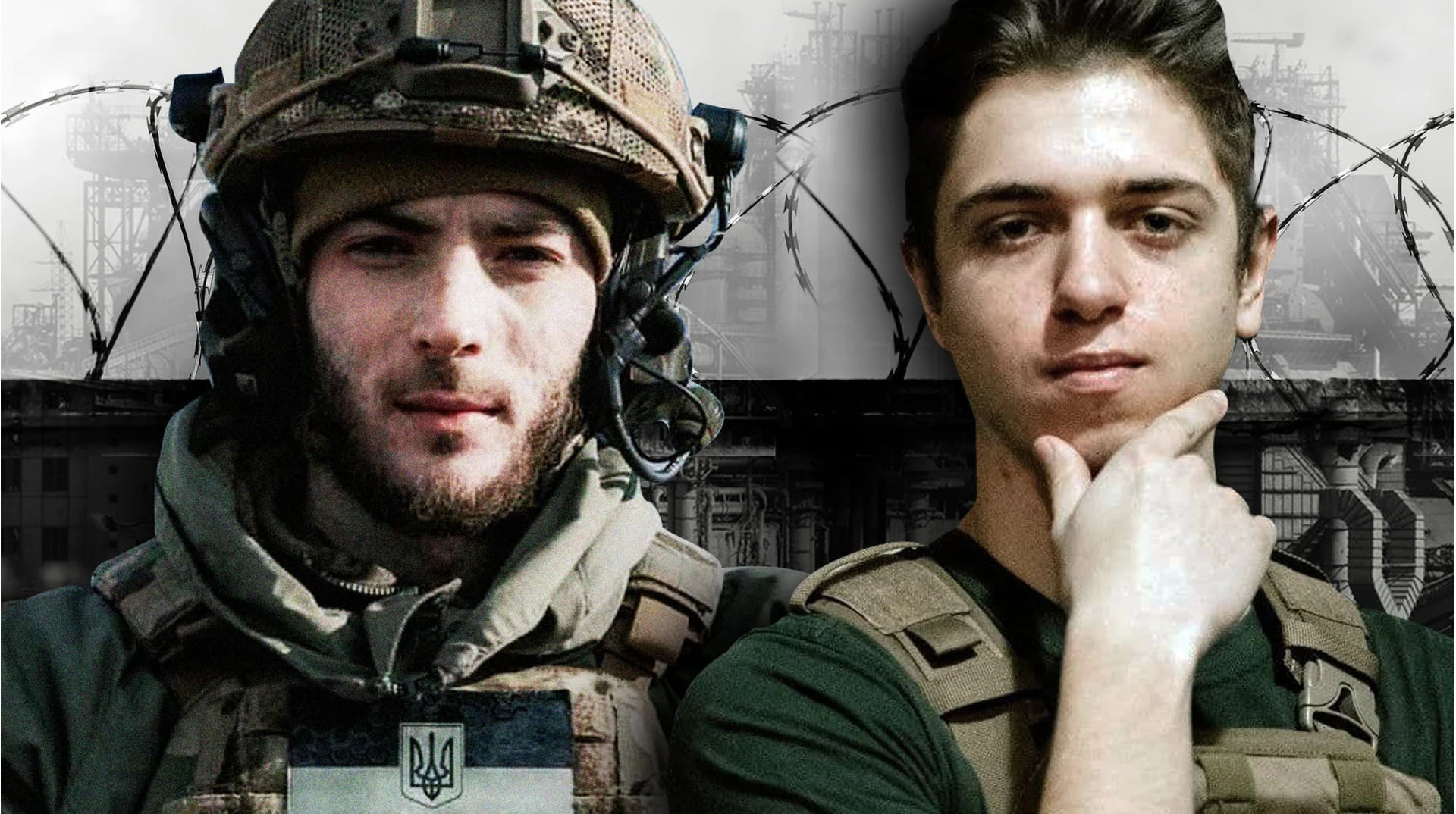
A son and brother were "found" thanks to a YouTube video. How Russia is hiding captured Azov soldiers from the world
Source: Ukrainska Pravda
Author: Olena Barsukova
"Two Azov soldiers were brought into the cell: one is 27 years old, the other 23. They are beaten and exhausted. Their backs are lacerated by whips, and their bodies bear marks from stun guns. They are currently under preventive detention, and an investigation is underway."
The families of Azov fighters Dmytro Samchenko and Oleksandr Dakhnenko recently heard this news from a Russian human rights activist’s YouTube broadcast.
Thanks to this interview, the families of the fighters learned of their fate for the first time in their third year of captivity—that is, of the torture and “investigation” based on fabricated charges.
Dmytro Samchenko, 27, and Oleksandr Dakhnenko, 23, are defenders of Mariupol who left the Azovstal steelworks in May 2022. Since then, their connection to the outside world has effectively been severed.
Oleksandr and Dmytro were not even seen in Russian propaganda videos. It was only recently revealed that the occupiers had transferred them from Pretrial Detention Center No. 2 in Taganrog to Pretrial Detention Center No. 1 in Rostov-on-Don.
According to a Russian human rights activist, the Azov soldiers were tortured into giving testimony about the “killing of civilians,” and thus a show trial awaits them.
Oleksandr’s mother, Olga, and Dmytro’s sister, Yulia, met at a gathering at the Coordination Headquarters and have since been working together to save their loved ones from Russian torture chambers. The women had never given interviews about the men, but when they learned of the fabricated investigation, they could no longer maintain their “silence.”
Today, Olga Dakhnenko and Yulia Samchenko are appealing to the international community with two requests: to urgently obtain information about the health of Oleksandr and Dmytro, and to include them in the next prisoner exchange.
The women shared their story with “Ukrainska Pravda. Life."
Dmytro Samchenko, call sign “Monolith,” is a junior sergeant with “Azov.” He grew up in Borodianka, in the Bucha district of Kyiv Oblast, alongside his older sister Yulia.
Initially, the military draft office sent the 18-year-old home due to a congenital heart defect, so he chose to volunteer for Azov while simultaneously studying law at university.
In February 2022, Dmytro went to defend Mariupol. His hometown of Borodianka quickly fell under occupation, but the soldier’s family managed to evacuate a few days before enemy tanks began rolling through the streets, and their home was ransacked and looted by the Russians.
Yulia says that at the start of the full-scale war, she worried more about her brother than herself—they had been close since childhood.
“Dmytro and I are 10 years apart. It just so happened that Mom entrusted him to me from childhood. I looked after him, took him to preschool, put him to bed, and fed him. You know, I was like a second mom to him, because our parents were constantly working to get us on our feet,” Yulia says.
During the defense of Mariupol, contact with Dmytro was rare. The family knows only that in March 2022, Dmytro was wounded and has been at Azovstal ever since.
“He didn’t have time to talk to us for long; he’d just sometimes reply to let us know he was alive. In March, he was wounded, and since then he’s been in a hospital in a bunker,” Yulia says.
On May 17, Yulia received a message from Dmytro for the last time, but there was no mention of captivity—her brother had only sent a few photos of himself. The next day, she saw her brother in one of the most famous images showing fighters leaving the Azovstal territory.
Yulia believed that everything would be fine for the “Azovstal” defenders in “honorable captivity” under the guarantees of international organizations. “Monolith’s” sister could not even imagine the abuse that awaited the fighters.
"In the second half of June, I was contacted by people who identified themselves as representatives of the International Committee of the Red Cross and said they had seen my brother and that he had told them he was alive.
After that, no matter how many times I reached out, there was no information about my brother. They said, ‘As soon as we have access, we’ll get in touch with you.’ It’s been three years now, and no one has contacted me,” says Yulia.
It wasn’t until December 2022 that a soldier who had been held in the same cell as Dmytro returned from captivity. He told Yulia that after the exchange of commanders, Dmytro was transferred to Pretrial Detention Center No. 2 in Taganrog.
After the exchange on May 6, 2023, the released Azov soldiers told Yulia that they had heard the call sign “Monolith” in Taganrog, but nothing was known about his health.
The next time the woman heard news about her brother was not until August 2024. This information came from Russian human rights activist Olga Romanova regarding electric shock torture, a "confession" extracted by force, and Rostov Pretrial Detention Center No. 1.
"Two Azov fighters were brought into the cell. One is 27 years old (born in 1997), the other is 23 (born in 2000). Tortured and exhausted (...) They were transferred from Pretrial Detention Center No. 2 in Taganrog. Most were exchanged, but not them—they were put on hold. They have been held incommunicado for 2.5 years since leaving Azovstal.
A preventive measure has now been imposed on them, and an investigation is underway. Under torture, they gave testimony about the “killing of civilians.” No signs of torture were recorded at Pretrial Detention Center No. 1—the doctors refused to document them. "An FSB investigator lieutenant in the Rostov region personally participates in torture using electric shocks, the 'spinning monkey' method, and others," said Olga Romanova, and then named Dmitry and Alexander.
"Friends sent me this video and said that at the seven-minute mark, they’re talking about my brother. At first, there was shock, anger, tears. I just screamed and cried. For the first three or four days, my tears wouldn’t stop flowing.
The next day we went to the Coordination Headquarters and documented everything. We appealed to the SBU, the ICRC, and wrote letters to all the ambassadors and government agencies. Now I’m slowly coming to terms with it, because I realize that tears won’t help. We have to keep fighting and get him out,” says Yulia.
Yulia has teamed up with Oleksandr Dakhnenko’s mother, Olga. The women haven’t lost hope of saving their loved ones before Russia hands down a fabricated sentence, as prisoners are “sentenced” to terms ranging from 24–25 years to life imprisonment for fabricated war crimes.
In addition, the families fear that it will be difficult to exchange those who have been illegally convicted, because the Russians consider them “criminals” rather than prisoners of war.
“I wait for the exchange every day. I imagine Dima calling, me hearing his voice, and with his consent, I’ll go to him right away with my parents. Even if it’s in the middle of the night, whenever it is, I’m always ready to go.”
“If I could reach him, I would thank him for protecting us, for his strength, and tell him that we love him very much. “We’re waiting and doing everything we can to bring the prisoners home,” says Yulia.
She tries to stay strong, because that’s how “Monolith” and his comrades were—her role models in life.
To keep from breaking down emotionally, she recalls her brother’s sense of humor and strength, which remained even in the hardest times.
“Dima is brave, determined, and a loyal friend. If he sets a goal, he always goes for it. He’s a man of few words, but he has a great sense of humor. He was even born on April 1st, and he was so good at pranks that we’d have tears in our eyes from laughing,” recalls Yulia. “I constantly pray to God that Dima will have faith, strength, and health to endure all of this. And I’m held up by the thought that he’ll come back.”
Oleksandr Dakhnenko is a Kyiv native who joined the Azov Regiment in late 2021, when he was 21 years old.
He was fascinated by technology and loved motorcycles, was interested in history, and graduated from the History Department of Mykhailo Dragomanov National University. During his student years, he went on archaeological excavations, but instead of a career as an archaeologist, he chose military service. He decided to join Azov because he had acquaintances there.
Oleksandr went to Mariupol just 2–3 months before the start of the full-scale war. He has now been in captivity for much longer than he served.
“Sasha had just arrived at the base in Urzuf. He had never been to that area before; we didn’t vacation there. During his short time of service, he didn’t even have time to get to know all his comrades. He only knew a small group of people who were close to him.
That later became a problem. I couldn’t find my son for a long time, and no one could tell me about him because hardly anyone knew him,” says Olga.
In Mariupol, Oleksandr rarely got in touch. The family could only watch the news showing Russians shelling Mariupol with phosphorus munitions and dropping five-ton bombs on Azovstal.
“Sometimes you’d check your phone, see that there had been recent activity, and your mother’s heart would stop worrying just a little, because you realize he’s alive. And if your child sends a little “like,” then you’re a happy mom.
He rarely called and said, “Mom, we’re holding on.” That’s what happened on my birthday, February 28. “I don’t know how he managed to get through, but he wished me a happy birthday. We spoke for literally thirty seconds, but it was probably the best birthday present of my life,” the woman recalls.
Once, Oleksandr called his mom and tried to prepare her for the worst-case scenario. He said, “This might be the end,” but Olga convinced her son that he would definitely return alive.
Oleksandr was indeed lucky to survive the defense of Mariupol. In the second half of May, he left Azovstal on orders and warned his mother about it. Then came the detention center in Olenivka, short messages from unknown numbers, news of the attack on “Barrack 200,” and then relief, because Oleksandr wasn’t there.
"In June, I received short text messages from an unknown number: 'Alive, unharmed.' I knew he wasn’t the one writing them—maybe one of his comrades was sending word.
The attack in Olenivka—that was just something terrible. I was lucky that I didn’t know about it at first, and then people called me back and immediately said: ‘Olya, don’t worry, he’s not on the list.’ It was just horrific. “I prayed because there was nothing else I could do,” Olga recalls.
For 2.5 years, Olga never once saw a photo or video of Oleksandr on Russian channels. In fact, she wasn’t ready to look for propaganda videos with fake interviews and mockery of prisoners.
"I believed that God was protecting my child, and I tried for a very long time to stay calm because I understood that our authorities were taking care of the prisoners. Then I realized why there had been no information for so long. After Olenivka, the Russians took our boys to Taganrog, and the prison there is so tightly sealed that no information leaks out.
On August 8, an interview with Olga Romanova—who was designated a “foreign agent” in Russia and now lives in Berlin—was posted in our parents’ group. I immediately sensed she was talking about my Sasha, even before she mentioned his last name. “My boy has been found,” says the Azov soldier’s mother.
For the first time in nearly three years, Olga Dakhnenko learned that her son was alive. But upon hearing the state he was in, Olga was horrified.
“This isn’t just a violation of the Geneva Conventions—it’s a violation of all human laws. To torment people like this, to force confessions out of them for things they didn’t do and couldn’t have done…
Many of the boys have already been transported to the other side of the world to terrible prisons. That’s why Yulia and I now want to do everything we can to stop this. I have to rescue my boy from captivity. But at the same time, I want to help the mothers of other captured defenders, so we need to raise awareness. These young men are our golden generation. They were the first to rush to defend Ukraine, so we have to get them out,” the woman says.
Olga admits: she would very much like to tell her son that he is a hero. She feels that he is holding on, and that gives her strength. The woman also finds support among other relatives of the captives—the mothers, wives, sisters, and fiancées of Mariupol’s defenders.
"In our community, we are all alike in our grief; we support one another and fight together. Perhaps if our boys were treated the way Ukraine treats Russian prisoners of war, we would be waiting for the war to end. But when we see that the boys, confirmed by the Red Cross, are returning home in black body bags, we realize that we must knock, fight, and wrest our children free.
“We ask the international community to stop being ‘concerned and worried’ and to help us free our defenders. Because they are the wall that shields the civilized world from monsters,” says the mother of an Azov soldier.
Alexander’s entire family dreams of a prisoner exchange that will finally include his name. At home, the Azov soldier’s parents, younger brother, and two beloved cats are waiting for him.
"I want my son to call me and say, 'Mom, I’m in Ukraine.' I don’t know how I’ll react: whether I’ll cry, faint from joy, or be unable to say anything at all. But the main thing is that this call happens.
I’m sure I’ll just think: ‘Lord, thank you for hearing me and bringing my boy back.’ "It will be the happiest day of my life," Olga dreams.
Author: Olena Barsukova
"Two Azov soldiers were brought into the cell: one is 27 years old, the other 23. They are beaten and exhausted. Their backs are lacerated by whips, and their bodies bear marks from stun guns. They are currently under preventive detention, and an investigation is underway."
The families of Azov fighters Dmytro Samchenko and Oleksandr Dakhnenko recently heard this news from a Russian human rights activist’s YouTube broadcast.
Thanks to this interview, the families of the fighters learned of their fate for the first time in their third year of captivity—that is, of the torture and “investigation” based on fabricated charges.
Dmytro Samchenko, 27, and Oleksandr Dakhnenko, 23, are defenders of Mariupol who left the Azovstal steelworks in May 2022. Since then, their connection to the outside world has effectively been severed.
Oleksandr and Dmytro were not even seen in Russian propaganda videos. It was only recently revealed that the occupiers had transferred them from Pretrial Detention Center No. 2 in Taganrog to Pretrial Detention Center No. 1 in Rostov-on-Don.
According to a Russian human rights activist, the Azov soldiers were tortured into giving testimony about the “killing of civilians,” and thus a show trial awaits them.
Oleksandr’s mother, Olga, and Dmytro’s sister, Yulia, met at a gathering at the Coordination Headquarters and have since been working together to save their loved ones from Russian torture chambers. The women had never given interviews about the men, but when they learned of the fabricated investigation, they could no longer maintain their “silence.”
Today, Olga Dakhnenko and Yulia Samchenko are appealing to the international community with two requests: to urgently obtain information about the health of Oleksandr and Dmytro, and to include them in the next prisoner exchange.
The women shared their story with “Ukrainska Pravda. Life."
Dmytro Samchenko, 27
Dmytro Samchenko, call sign “Monolith,” is a junior sergeant with “Azov.” He grew up in Borodianka, in the Bucha district of Kyiv Oblast, alongside his older sister Yulia.
Initially, the military draft office sent the 18-year-old home due to a congenital heart defect, so he chose to volunteer for Azov while simultaneously studying law at university.
In February 2022, Dmytro went to defend Mariupol. His hometown of Borodianka quickly fell under occupation, but the soldier’s family managed to evacuate a few days before enemy tanks began rolling through the streets, and their home was ransacked and looted by the Russians.
Yulia says that at the start of the full-scale war, she worried more about her brother than herself—they had been close since childhood.
“Dmytro and I are 10 years apart. It just so happened that Mom entrusted him to me from childhood. I looked after him, took him to preschool, put him to bed, and fed him. You know, I was like a second mom to him, because our parents were constantly working to get us on our feet,” Yulia says.
During the defense of Mariupol, contact with Dmytro was rare. The family knows only that in March 2022, Dmytro was wounded and has been at Azovstal ever since.
“He didn’t have time to talk to us for long; he’d just sometimes reply to let us know he was alive. In March, he was wounded, and since then he’s been in a hospital in a bunker,” Yulia says.
On May 17, Yulia received a message from Dmytro for the last time, but there was no mention of captivity—her brother had only sent a few photos of himself. The next day, she saw her brother in one of the most famous images showing fighters leaving the Azovstal territory.
Yulia believed that everything would be fine for the “Azovstal” defenders in “honorable captivity” under the guarantees of international organizations. “Monolith’s” sister could not even imagine the abuse that awaited the fighters.
"In the second half of June, I was contacted by people who identified themselves as representatives of the International Committee of the Red Cross and said they had seen my brother and that he had told them he was alive.
After that, no matter how many times I reached out, there was no information about my brother. They said, ‘As soon as we have access, we’ll get in touch with you.’ It’s been three years now, and no one has contacted me,” says Yulia.
It wasn’t until December 2022 that a soldier who had been held in the same cell as Dmytro returned from captivity. He told Yulia that after the exchange of commanders, Dmytro was transferred to Pretrial Detention Center No. 2 in Taganrog.
After the exchange on May 6, 2023, the released Azov soldiers told Yulia that they had heard the call sign “Monolith” in Taganrog, but nothing was known about his health.
The next time the woman heard news about her brother was not until August 2024. This information came from Russian human rights activist Olga Romanova regarding electric shock torture, a "confession" extracted by force, and Rostov Pretrial Detention Center No. 1.
"Two Azov fighters were brought into the cell. One is 27 years old (born in 1997), the other is 23 (born in 2000). Tortured and exhausted (...) They were transferred from Pretrial Detention Center No. 2 in Taganrog. Most were exchanged, but not them—they were put on hold. They have been held incommunicado for 2.5 years since leaving Azovstal.
A preventive measure has now been imposed on them, and an investigation is underway. Under torture, they gave testimony about the “killing of civilians.” No signs of torture were recorded at Pretrial Detention Center No. 1—the doctors refused to document them. "An FSB investigator lieutenant in the Rostov region personally participates in torture using electric shocks, the 'spinning monkey' method, and others," said Olga Romanova, and then named Dmitry and Alexander.
"Friends sent me this video and said that at the seven-minute mark, they’re talking about my brother. At first, there was shock, anger, tears. I just screamed and cried. For the first three or four days, my tears wouldn’t stop flowing.
The next day we went to the Coordination Headquarters and documented everything. We appealed to the SBU, the ICRC, and wrote letters to all the ambassadors and government agencies. Now I’m slowly coming to terms with it, because I realize that tears won’t help. We have to keep fighting and get him out,” says Yulia.
Yulia has teamed up with Oleksandr Dakhnenko’s mother, Olga. The women haven’t lost hope of saving their loved ones before Russia hands down a fabricated sentence, as prisoners are “sentenced” to terms ranging from 24–25 years to life imprisonment for fabricated war crimes.
In addition, the families fear that it will be difficult to exchange those who have been illegally convicted, because the Russians consider them “criminals” rather than prisoners of war.
“I wait for the exchange every day. I imagine Dima calling, me hearing his voice, and with his consent, I’ll go to him right away with my parents. Even if it’s in the middle of the night, whenever it is, I’m always ready to go.”
“If I could reach him, I would thank him for protecting us, for his strength, and tell him that we love him very much. “We’re waiting and doing everything we can to bring the prisoners home,” says Yulia.
She tries to stay strong, because that’s how “Monolith” and his comrades were—her role models in life.
To keep from breaking down emotionally, she recalls her brother’s sense of humor and strength, which remained even in the hardest times.
“Dima is brave, determined, and a loyal friend. If he sets a goal, he always goes for it. He’s a man of few words, but he has a great sense of humor. He was even born on April 1st, and he was so good at pranks that we’d have tears in our eyes from laughing,” recalls Yulia. “I constantly pray to God that Dima will have faith, strength, and health to endure all of this. And I’m held up by the thought that he’ll come back.”
Oleksandr Dakhnenko, 23
Oleksandr Dakhnenko is a Kyiv native who joined the Azov Regiment in late 2021, when he was 21 years old.
He was fascinated by technology and loved motorcycles, was interested in history, and graduated from the History Department of Mykhailo Dragomanov National University. During his student years, he went on archaeological excavations, but instead of a career as an archaeologist, he chose military service. He decided to join Azov because he had acquaintances there.
Oleksandr went to Mariupol just 2–3 months before the start of the full-scale war. He has now been in captivity for much longer than he served.
“Sasha had just arrived at the base in Urzuf. He had never been to that area before; we didn’t vacation there. During his short time of service, he didn’t even have time to get to know all his comrades. He only knew a small group of people who were close to him.
That later became a problem. I couldn’t find my son for a long time, and no one could tell me about him because hardly anyone knew him,” says Olga.
In Mariupol, Oleksandr rarely got in touch. The family could only watch the news showing Russians shelling Mariupol with phosphorus munitions and dropping five-ton bombs on Azovstal.
“Sometimes you’d check your phone, see that there had been recent activity, and your mother’s heart would stop worrying just a little, because you realize he’s alive. And if your child sends a little “like,” then you’re a happy mom.
He rarely called and said, “Mom, we’re holding on.” That’s what happened on my birthday, February 28. “I don’t know how he managed to get through, but he wished me a happy birthday. We spoke for literally thirty seconds, but it was probably the best birthday present of my life,” the woman recalls.
Once, Oleksandr called his mom and tried to prepare her for the worst-case scenario. He said, “This might be the end,” but Olga convinced her son that he would definitely return alive.
Oleksandr was indeed lucky to survive the defense of Mariupol. In the second half of May, he left Azovstal on orders and warned his mother about it. Then came the detention center in Olenivka, short messages from unknown numbers, news of the attack on “Barrack 200,” and then relief, because Oleksandr wasn’t there.
"In June, I received short text messages from an unknown number: 'Alive, unharmed.' I knew he wasn’t the one writing them—maybe one of his comrades was sending word.
The attack in Olenivka—that was just something terrible. I was lucky that I didn’t know about it at first, and then people called me back and immediately said: ‘Olya, don’t worry, he’s not on the list.’ It was just horrific. “I prayed because there was nothing else I could do,” Olga recalls.
For 2.5 years, Olga never once saw a photo or video of Oleksandr on Russian channels. In fact, she wasn’t ready to look for propaganda videos with fake interviews and mockery of prisoners.
"I believed that God was protecting my child, and I tried for a very long time to stay calm because I understood that our authorities were taking care of the prisoners. Then I realized why there had been no information for so long. After Olenivka, the Russians took our boys to Taganrog, and the prison there is so tightly sealed that no information leaks out.
On August 8, an interview with Olga Romanova—who was designated a “foreign agent” in Russia and now lives in Berlin—was posted in our parents’ group. I immediately sensed she was talking about my Sasha, even before she mentioned his last name. “My boy has been found,” says the Azov soldier’s mother.
For the first time in nearly three years, Olga Dakhnenko learned that her son was alive. But upon hearing the state he was in, Olga was horrified.
“This isn’t just a violation of the Geneva Conventions—it’s a violation of all human laws. To torment people like this, to force confessions out of them for things they didn’t do and couldn’t have done…
Many of the boys have already been transported to the other side of the world to terrible prisons. That’s why Yulia and I now want to do everything we can to stop this. I have to rescue my boy from captivity. But at the same time, I want to help the mothers of other captured defenders, so we need to raise awareness. These young men are our golden generation. They were the first to rush to defend Ukraine, so we have to get them out,” the woman says.
Olga admits: she would very much like to tell her son that he is a hero. She feels that he is holding on, and that gives her strength. The woman also finds support among other relatives of the captives—the mothers, wives, sisters, and fiancées of Mariupol’s defenders.
"In our community, we are all alike in our grief; we support one another and fight together. Perhaps if our boys were treated the way Ukraine treats Russian prisoners of war, we would be waiting for the war to end. But when we see that the boys, confirmed by the Red Cross, are returning home in black body bags, we realize that we must knock, fight, and wrest our children free.
“We ask the international community to stop being ‘concerned and worried’ and to help us free our defenders. Because they are the wall that shields the civilized world from monsters,” says the mother of an Azov soldier.
Alexander’s entire family dreams of a prisoner exchange that will finally include his name. At home, the Azov soldier’s parents, younger brother, and two beloved cats are waiting for him.
"I want my son to call me and say, 'Mom, I’m in Ukraine.' I don’t know how I’ll react: whether I’ll cry, faint from joy, or be unable to say anything at all. But the main thing is that this call happens.
I’m sure I’ll just think: ‘Lord, thank you for hearing me and bringing my boy back.’ "It will be the happiest day of my life," Olga dreams.
This is an automatic translation generated by DeepL.