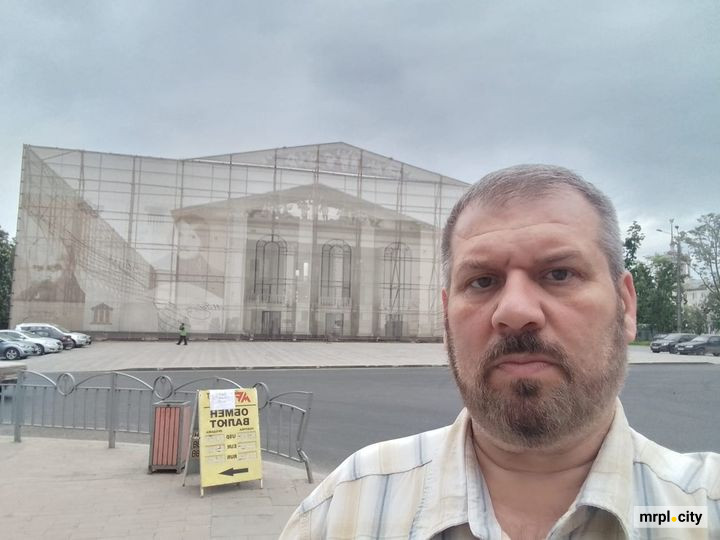
A Month with a Bag Over His Head and Life in a Detention Center—Mariupol Filmmaker Anatoliy Levchenko Tells His Story
Source: MRPL.CITY
Author: Olga Demidko
Artistic Director and Director of Mariupol’s First Non-State Theater “Terra Incognita” (Our Theater for Our People) Anatoliy Levchenko, having left the temporarily occupied city of Mariupol, gave a detailed and candid interview in which he spoke exclusively to mrpl.city about how he was taken prisoner and how he managed to escape to territory controlled by Ukraine.
Anatoliy Mykolayovych, tell us what you remember about February 24 and the first few days after the full-scale invasion?
I knew this war was coming. The only thing I regret is that I trusted the city’s leadership. If I’d realized that everything the mayor said was a lie, I would have evacuated my family immediately. So many people died in Mariupol… I saw the numbers with my own eyes at one of the funeral homes in occupied Mariupol: 86,000 Mariupol residents buried and about 20,000 unidentified bodies. I remember how, in the neighborhood where I lived, more and more new graves appeared in a short period of time. When looting began in Mariupol, I tried to find some food for my son. After all, he’s a child with special needs and won’t eat just anything. Tea and sugar saved me—we had plenty of both at home thanks to my mother-in-law’s habits. But Artem was always fixated on one particular food, which, unfortunately, wasn’t available during the blockade.
Where was your family during the heaviest shelling in the city?
During the heavy shelling, my family was on the 9th floor of our building, where we lived. By the way, our windows faced Azovstal, and we could see everything that was happening. We didn’t go down to the basement because it’s a long way down and we would have had to jump, and I have a 92-year-old mother-in-law and a son with autism.
How did you and your family survive the blockade? What has stuck in your memory?
It was hardest on my son, of course. He wouldn’t eat anything, lay in bed for long periods, and began to develop bedsores. Within two weeks, he started howling like a dog… And then his voice became completely hoarse. My wife tried to take care of household chores. I stood in line for 5 to 7 hours at a time to get water. I remember a line four rows deep stretching from the water utility to the Central Market. I’d arrive at 8 a.m. and get in line. I can say for certain that those who were good people remained so. But there were those who even took the last pastries away from children…
I buried my mother-in-law on the lawn near our house on April 2. She passed away in my wife’s arms. She died of dehydration. She loved her grandson very much. Right up until the end, she brought him her homemade cookies and hid them under Artem’s pillow.
Did you try to leave the city?
Of course, I tried to leave. But I didn’t have my own car. In May, I found a man who offered to take me and my family out of the city. I had my own savings at the time and hoped everything would work out. By then, screening was already required. I went to undergo screening on May 17, but as it turned out, reports had already been filed against me, even though they didn’t know my address. And when I showed up for the screening, I was flagged…
Do you know who filed reports against you?
I know that reports against me began to be filed as early as March. Everyone knows that I collaborated with Ukrainian patriots, and I’ve spoken more than once about what was happening at the Donetsk Academic Regional Drama Theater (in Mariupol)—namely, that there were many open anti-Ukrainians there. I know for certain that there were several reports. An operative told me about this as well. They were written to prove their loyalty to the occupying authorities. They were likely my former theater colleagues.
How did you end up in captivity? What do you remember about that day?
It happened on May 20. I remember them holding a gun to my temple. I was very glad that by that time I had given all the data from my computer’s hard drive to my friends. When they came for me, my wife wasn’t home—she had gone to the market to buy cottage cheese for our son. I asked them to wait for my wife and pointed out my son’s condition. But they said they wouldn’t wait. Luckily, a neighbor agreed to stay with him. They put a bag over my head and put me in a car. The drive took three hours. I was placed in a detention center in Donetsk at 2 Svitlyi Shlyakh Street. I spent the first month of my detention with a bag over my head. They only took it off when they gave me food. Then they transferred me to another detention center on Kobozeva Street.
What were you accused of?
On June 16, I was formally charged. I spent a whole month there without any charges, just waiting. They took me in for various interrogations. The guys who spoke with me were quite uneducated. They charged me under “DNR” law. They pinned Article 328 on me—inciting interethnic hatred. They asked me about my plays. But due to their own lack of education and illiteracy, they couldn’t even ask the questions correctly. They still couldn’t find anything in my plays “Glory to the Heroes” or “Maidan Inferno.” Then they moved on to my Facebook posts. A young 25-year-old investigator began working on my case. They started accusing me of insulting the foundations of the “DNR.” They saw my post showing a tower with a star on fire. Two people are standing nearby. And the caption read: “Love is looking in the same direction!” They accused me of calling on the people of Mariupol to set fire to the Kremlin in Moscow. They also found a video of mine where some guys were doing a humorous reenactment of the UPA era. They claimed I was calling for the murder of Russians with the help of UPA fighters. I tried to explain to them that the UPA no longer exists, but it was all very difficult there. On October 14, they added two charges of extremism and terrorist activity. That could have meant up to 12 years.
How were you treated? Were physical methods used to “converse” with you?
The biggest issue was psychological pressure. Of course, they might hit me with a rifle butt, but they didn’t torture me. However, my cellmates were subjected to electric shocks. The worst part for me was the waiting and not knowing what would happen next. Behind bars, all my chronic illnesses worsened. At first, they put me in a 4x2-meter cell. I was there with four criminals. But one of them told me that he had even gone to see my performances before the war. While I was behind bars, I heard how they were mocking our soldiers. There was a window in the cell, and we could hear what the guards were saying. Five thousand soldiers were also charged with terrorist activities. I hope that prisoner exchanges will be better organized and our guys will return home… Then I was transferred to the political prisoners’ section. But there were also DNR members there. All kinds of people, really.
When were you allowed to correspond with your wife?
On June 16, the investigator told me to write down what I needed. That’s when I wrote my first letter to my wife. I asked her to take our son away for rehabilitation. I wanted her to leave the occupied city. In July, I received my first letter from my wife. She told me that the electricity had been restored. She asked me to do everything possible to survive, because I had promised her that earlier. All the letters were checked. To send me everything I needed, she had to travel to Donetsk. Basically, she was left alone with our son. She had to carry water up to the 9th floor by herself. I understand that it was very hard for her, both physically and psychologically. The letters took a very long time to arrive. There were problems with the mail. I sent a letter in October and immediately wished her a Happy New Year. But she later told me that she didn’t receive that letter until January.
When were you released, and how did that happen?
In October, the “DNR” legislation was brought into line with Russian law. And then many questions arose regarding my charges. The offense I was charged with in the “DNR” under Russian law for a first offense had been decriminalized. The other two charges were brought under “DNR” legislation at a time when the occupiers already considered this territory to be Russian—meaning they were violating their own laws. I had already written many petitions regarding my case. People told me not to write anything, saying they’d let me go anyway. There were rumors that someone in the media had interceded on my behalf. My wife gathered positive character references for me from our neighbors. They wrote that I was a good person who never meant any harm. I was released on a travel ban on March 9, the Kobzar’s birthday. I tried not to talk to anyone and didn’t go outside. I was in poor health, so I stayed home at first. In April, the travel ban was lifted. The prosecutor did not pursue the charges. The preliminary investigation continued. During this time, I began raising funds to leave the country. In May, the investigator called and told me to write a statement saying that all my Facebook posts were jokes. In June, I was summoned again. They rewrote half the case file. Despite all my requests, they didn’t return my phone to me. The investigator said she hoped we wouldn’t see each other again. To which I replied that I couldn’t promise that. I asked the investigator if they would let me through at the border. She assured me that no one would stop me and that I could go. But after everything I’d been through, I still couldn’t trust her words.
How did you travel to the territory controlled by Ukraine? Have you settled in Kropyvnytskyi yet? What are your immediate plans?
On July 23, my family and I crossed the border from the Belgorod region into the city of Sumy. The journey was very difficult, and we spent a lot of money. I didn’t sleep at all during the night while we were traveling. I was constantly worried that we might be detained. The hardest part was a 2-kilometer stretch through the gray zone, which we had to cover on foot with all our suitcases and a tired child. Here in Kropyvnytskyi, we’re currently working every day on getting the necessary paperwork in order. I’m very grateful to everyone who helped me and my family leave. I’m already preparing new theater projects and plan to revive some of our productions. In particular, I want to put together a project featuring photos of my theater’s productions alongside unique photographs by Mariupol photographers Stanislav Ivanov, Lev Sandalov, and Yevgeny Sosnovsky. Of course, I’m really looking forward to meeting people from Mariupol in the capital, where I hope to hold a creative event to present this project, thank everyone who helped us leave, share my personal experiences, and answer all the questions from my fellow Mariupol residents…
Author: Olga Demidko
Artistic Director and Director of Mariupol’s First Non-State Theater “Terra Incognita” (Our Theater for Our People) Anatoliy Levchenko, having left the temporarily occupied city of Mariupol, gave a detailed and candid interview in which he spoke exclusively to mrpl.city about how he was taken prisoner and how he managed to escape to territory controlled by Ukraine.
Anatoliy Mykolayovych, tell us what you remember about February 24 and the first few days after the full-scale invasion?
I knew this war was coming. The only thing I regret is that I trusted the city’s leadership. If I’d realized that everything the mayor said was a lie, I would have evacuated my family immediately. So many people died in Mariupol… I saw the numbers with my own eyes at one of the funeral homes in occupied Mariupol: 86,000 Mariupol residents buried and about 20,000 unidentified bodies. I remember how, in the neighborhood where I lived, more and more new graves appeared in a short period of time. When looting began in Mariupol, I tried to find some food for my son. After all, he’s a child with special needs and won’t eat just anything. Tea and sugar saved me—we had plenty of both at home thanks to my mother-in-law’s habits. But Artem was always fixated on one particular food, which, unfortunately, wasn’t available during the blockade.
Where was your family during the heaviest shelling in the city?
During the heavy shelling, my family was on the 9th floor of our building, where we lived. By the way, our windows faced Azovstal, and we could see everything that was happening. We didn’t go down to the basement because it’s a long way down and we would have had to jump, and I have a 92-year-old mother-in-law and a son with autism.
How did you and your family survive the blockade? What has stuck in your memory?
It was hardest on my son, of course. He wouldn’t eat anything, lay in bed for long periods, and began to develop bedsores. Within two weeks, he started howling like a dog… And then his voice became completely hoarse. My wife tried to take care of household chores. I stood in line for 5 to 7 hours at a time to get water. I remember a line four rows deep stretching from the water utility to the Central Market. I’d arrive at 8 a.m. and get in line. I can say for certain that those who were good people remained so. But there were those who even took the last pastries away from children…
I buried my mother-in-law on the lawn near our house on April 2. She passed away in my wife’s arms. She died of dehydration. She loved her grandson very much. Right up until the end, she brought him her homemade cookies and hid them under Artem’s pillow.
Did you try to leave the city?
Of course, I tried to leave. But I didn’t have my own car. In May, I found a man who offered to take me and my family out of the city. I had my own savings at the time and hoped everything would work out. By then, screening was already required. I went to undergo screening on May 17, but as it turned out, reports had already been filed against me, even though they didn’t know my address. And when I showed up for the screening, I was flagged…
Do you know who filed reports against you?
I know that reports against me began to be filed as early as March. Everyone knows that I collaborated with Ukrainian patriots, and I’ve spoken more than once about what was happening at the Donetsk Academic Regional Drama Theater (in Mariupol)—namely, that there were many open anti-Ukrainians there. I know for certain that there were several reports. An operative told me about this as well. They were written to prove their loyalty to the occupying authorities. They were likely my former theater colleagues.
How did you end up in captivity? What do you remember about that day?
It happened on May 20. I remember them holding a gun to my temple. I was very glad that by that time I had given all the data from my computer’s hard drive to my friends. When they came for me, my wife wasn’t home—she had gone to the market to buy cottage cheese for our son. I asked them to wait for my wife and pointed out my son’s condition. But they said they wouldn’t wait. Luckily, a neighbor agreed to stay with him. They put a bag over my head and put me in a car. The drive took three hours. I was placed in a detention center in Donetsk at 2 Svitlyi Shlyakh Street. I spent the first month of my detention with a bag over my head. They only took it off when they gave me food. Then they transferred me to another detention center on Kobozeva Street.
What were you accused of?
On June 16, I was formally charged. I spent a whole month there without any charges, just waiting. They took me in for various interrogations. The guys who spoke with me were quite uneducated. They charged me under “DNR” law. They pinned Article 328 on me—inciting interethnic hatred. They asked me about my plays. But due to their own lack of education and illiteracy, they couldn’t even ask the questions correctly. They still couldn’t find anything in my plays “Glory to the Heroes” or “Maidan Inferno.” Then they moved on to my Facebook posts. A young 25-year-old investigator began working on my case. They started accusing me of insulting the foundations of the “DNR.” They saw my post showing a tower with a star on fire. Two people are standing nearby. And the caption read: “Love is looking in the same direction!” They accused me of calling on the people of Mariupol to set fire to the Kremlin in Moscow. They also found a video of mine where some guys were doing a humorous reenactment of the UPA era. They claimed I was calling for the murder of Russians with the help of UPA fighters. I tried to explain to them that the UPA no longer exists, but it was all very difficult there. On October 14, they added two charges of extremism and terrorist activity. That could have meant up to 12 years.
How were you treated? Were physical methods used to “converse” with you?
The biggest issue was psychological pressure. Of course, they might hit me with a rifle butt, but they didn’t torture me. However, my cellmates were subjected to electric shocks. The worst part for me was the waiting and not knowing what would happen next. Behind bars, all my chronic illnesses worsened. At first, they put me in a 4x2-meter cell. I was there with four criminals. But one of them told me that he had even gone to see my performances before the war. While I was behind bars, I heard how they were mocking our soldiers. There was a window in the cell, and we could hear what the guards were saying. Five thousand soldiers were also charged with terrorist activities. I hope that prisoner exchanges will be better organized and our guys will return home… Then I was transferred to the political prisoners’ section. But there were also DNR members there. All kinds of people, really.
When were you allowed to correspond with your wife?
On June 16, the investigator told me to write down what I needed. That’s when I wrote my first letter to my wife. I asked her to take our son away for rehabilitation. I wanted her to leave the occupied city. In July, I received my first letter from my wife. She told me that the electricity had been restored. She asked me to do everything possible to survive, because I had promised her that earlier. All the letters were checked. To send me everything I needed, she had to travel to Donetsk. Basically, she was left alone with our son. She had to carry water up to the 9th floor by herself. I understand that it was very hard for her, both physically and psychologically. The letters took a very long time to arrive. There were problems with the mail. I sent a letter in October and immediately wished her a Happy New Year. But she later told me that she didn’t receive that letter until January.
When were you released, and how did that happen?
In October, the “DNR” legislation was brought into line with Russian law. And then many questions arose regarding my charges. The offense I was charged with in the “DNR” under Russian law for a first offense had been decriminalized. The other two charges were brought under “DNR” legislation at a time when the occupiers already considered this territory to be Russian—meaning they were violating their own laws. I had already written many petitions regarding my case. People told me not to write anything, saying they’d let me go anyway. There were rumors that someone in the media had interceded on my behalf. My wife gathered positive character references for me from our neighbors. They wrote that I was a good person who never meant any harm. I was released on a travel ban on March 9, the Kobzar’s birthday. I tried not to talk to anyone and didn’t go outside. I was in poor health, so I stayed home at first. In April, the travel ban was lifted. The prosecutor did not pursue the charges. The preliminary investigation continued. During this time, I began raising funds to leave the country. In May, the investigator called and told me to write a statement saying that all my Facebook posts were jokes. In June, I was summoned again. They rewrote half the case file. Despite all my requests, they didn’t return my phone to me. The investigator said she hoped we wouldn’t see each other again. To which I replied that I couldn’t promise that. I asked the investigator if they would let me through at the border. She assured me that no one would stop me and that I could go. But after everything I’d been through, I still couldn’t trust her words.
How did you travel to the territory controlled by Ukraine? Have you settled in Kropyvnytskyi yet? What are your immediate plans?
On July 23, my family and I crossed the border from the Belgorod region into the city of Sumy. The journey was very difficult, and we spent a lot of money. I didn’t sleep at all during the night while we were traveling. I was constantly worried that we might be detained. The hardest part was a 2-kilometer stretch through the gray zone, which we had to cover on foot with all our suitcases and a tired child. Here in Kropyvnytskyi, we’re currently working every day on getting the necessary paperwork in order. I’m very grateful to everyone who helped me and my family leave. I’m already preparing new theater projects and plan to revive some of our productions. In particular, I want to put together a project featuring photos of my theater’s productions alongside unique photographs by Mariupol photographers Stanislav Ivanov, Lev Sandalov, and Yevgeny Sosnovsky. Of course, I’m really looking forward to meeting people from Mariupol in the capital, where I hope to hold a creative event to present this project, thank everyone who helped us leave, share my personal experiences, and answer all the questions from my fellow Mariupol residents…
This is an automatic translation generated by DeepL.